
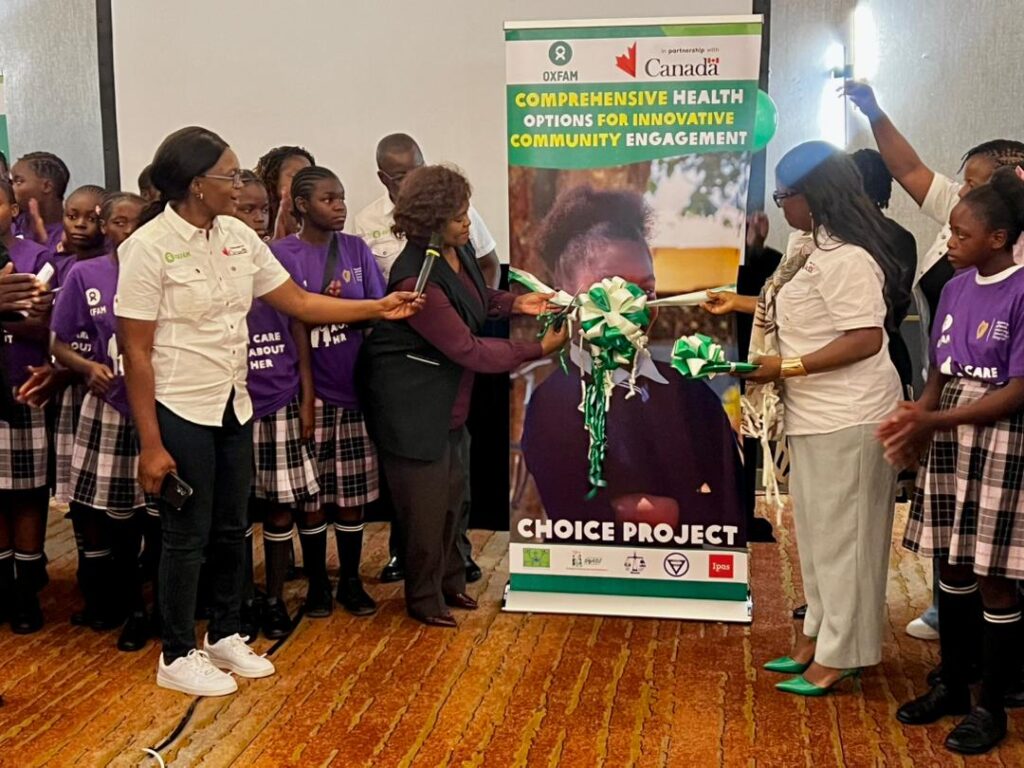
CHOICE Programme Set to Expand Contraceptive Access and Health Education for Young People
The Government of Zambia has reaffirmed its commitment to improving Sexual and Reproductive Health (SRH) outcomes for adolescents and young women with the launch of the CHOICE Programme, an initiative aimed at expanding access to quality, youth-friendly health services in Central and Southern Provinces.
Speaking on behalf of the Ministry of Health at the launch held at the InterContinental Hotel, Matilda Kakungu Simpungwe highlighted the urgency of addressing persistent SRH challenges affecting adolescents, including high rates of unintended pregnancies, sexually transmitted infections, and limited access to modern contraception.
The Comprehensive Health Options through Innovative Community Engagement (CHOICE) Programme, implemented by Oxfam and funded by Global Affairs Canada, will run for seven years, from 2025 to 2031.
The programme will be implemented in Zambia’s districts of Chisamba, Chibombo, Namwala, and Itezhi-Tezhi, while also being rolled out in Malawi, Zimbabwe, and Canada.
Dr Simpungwe noted that recent data from the Zambia Demographic and Health Survey indicate that teenage pregnancy remains a major public health concern, particularly in Southern Province, where the rate stands at 27.2 per cent, and in Central Province at 23.1 per cent.
She emphasised that these trends reflect persistent gaps in access to contraception, comprehensive sexuality education, and adolescent-friendly health services.
The Ministry of Health further acknowledged systemic challenges within the health sector, including limited adolescent-friendly spaces, a shortage of health workers trained in adolescent care, and the continued burden of communicable diseases such as HIV, malaria, and tuberculosis.
These challenges are recognised within national policy frameworks, including the National Health Strategic Plan, she noted.
Dr Simpungwe reaffirmed that the Government’s SRH priorities are aligned with the 8th National Development Plan, the National Health Strategy (2022–2026), and international commitments such as the Abuja Declaration, demonstrating sustained political and financial commitment to health sector reform.
She said the CHOICE Programme will be implemented in collaboration with local authorities and community organisations, focusing on improving access to contraception, strengthening reproductive health education, empowering young women, and addressing harmful socio-cultural norms.
Traditional leaders, schools, and health facilities will play a key role in ensuring community ownership and sustainability, Dr Simpungwe noted.
Declaring the programme officially launched, she called for collective action to ensure that adolescents and women in the target provinces are equipped with the information, services, and support they need to live healthy and empowered lives.