
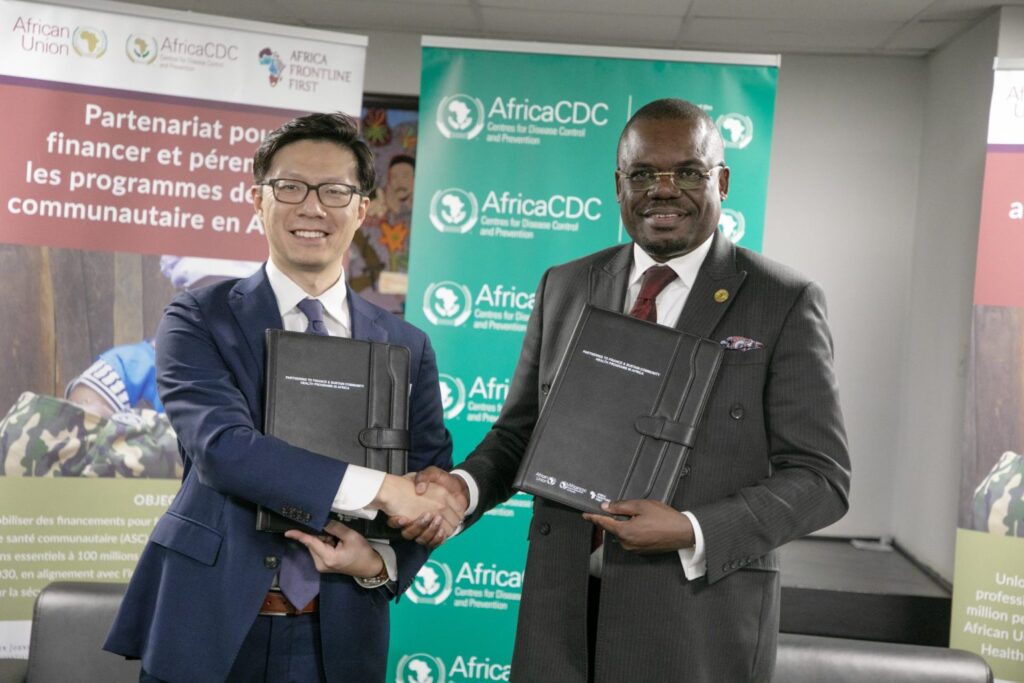
Africa Strengthens Community Health Financing with US$900 Million Commitment
The Africa Centres for Disease Control and Prevention and Africa Frontline First (AFF) have strengthened their collaboration to accelerate the expansion of community health workers across the continent.
The two organisations signed a Memorandum of Understanding on the sidelines of the World Health Summit Regional Meeting 2026 in Nairobi, setting out a joint action plan for 2026–2028.
The agreement aims to support the deployment of 200,000 community health workers (CHWs) and contribute to the African Union target of recruiting two million polyvalent CHWs by 2030.
Officials said the partnership will combine AFF’s financing and technical expertise with Africa CDC’s leadership and convening power to strengthen national health systems and improve access to primary healthcare services, particularly in underserved communities.
Since 2023, the collaboration between Africa CDC, AFF and partners such as the Global Fund has already led to the deployment and strengthening of more than 106,000 community health workers, alongside mobilising over US$218 million to support national programmes.
The initiative has also helped secure more than US$900 million in funding commitments for community health and supported governments in integrating CHWs into national health strategies and budgets.
Speaking at the signing ceremony, Africa CDC Director General, Dr Jean Kaseya, said the partnership marks a shift from commitments to action.
“Strategic partnerships like this are essential as we accelerate progress towards a stronger, more resilient primary healthcare system across Africa,” he said.
Nan Chen, Co-Executive Director of Africa Frontline First, emphasised the need for sustainable, locally driven health systems.
“This partnership is about building durable systems that reduce dependency and ensure community health efforts are owned and sustained within Africa,” she said.
Going forward, the partnership will focus on scaling deployment, strengthening financing, improving training and professionalisation, and integrating community health workers into broader health and emergency response systems.
Health experts say the renewed collaboration is expected to play a key role in improving healthcare delivery, enhancing resilience, and advancing health security across the continent.