AU Lays Out Bold Economic Reform Agenda for 2026
African Union Member States have convened to align on a coordinated strategy for the 2026 G20 cycle, as the continent seeks to strengthen its influence in global economic governance following its permanent membership in the forum.
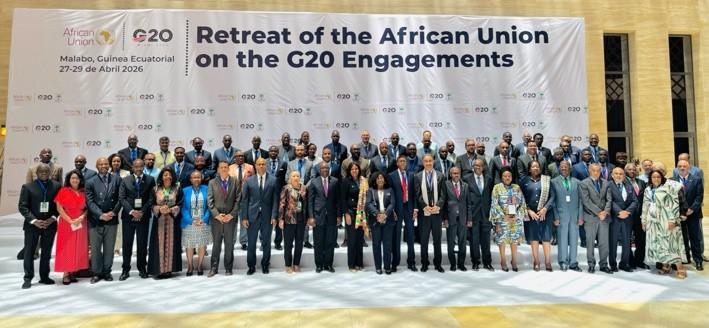
The high-level AU G20 Retreat, hosted by the Republic of Equatorial Guinea, brings together Member States, financial institutions and strategic partners to review progress from South Africa’s 2025 G20 Presidency and prepare for the United States’ 2026 chairmanship.
The discussions are centred on aligning Africa’s priorities under Agenda 2063, strengthening coordination across G20 tracks, and adopting a strategic roadmap for continental engagement.
Opening the retreat, Equatorial Guinea’s Minister of Foreign Affairs, Simeón Oyono Esono Angüe, said Africa is now actively shaping global decisions rather than merely observing them.
“This moment reflects a turning point in our diplomacy. We are no longer observing global decisions; we are actively co-authoring them to ensure they reflect the realities of our people,” he said.
African Union Commission Director General Fathallah Sijillmasi stressed the need for strong internal mechanisms to ensure Africa’s priorities are effectively advanced within the G20, including digital transformation, infrastructure financing and economic reform.
The AU’s G20 Sherpa, Commissioner Francisca Tatchouop Belobe, highlighted recent diplomatic concerns regarding developments under the upcoming US G20 Presidency, warning that inclusivity and consensus remain essential to the forum’s credibility.
She said the AU will continue engaging partners to safeguard Africa’s collective interests and ensure full participation in global decision-making processes.
Burundi’s Ambassador Willy Nyamitwe emphasised that Africa’s success in the G20 will be measured not by presence, but by tangible outcomes such as industrialisation, debt sustainability and inclusive growth for the continent’s 1.4 billion people.
“Our participation must deliver real impact that advances the aspirations of Agenda 2063,” he said.
Equatorial Guinea’s Minister of Finance, Iván Bacale Ebe Molina, called for reforms to the global financial system, stating that international economic structures must support Africa’s industrial and energy ambitions.
The retreat is expected to produce a unified strategic roadmap to guide Africa’s engagement in G20 working groups, ministerial meetings and leaders’ summits, while ensuring continuity as leadership transitions from Angola to Burundi in 2026.
According to the African Union, the overarching priorities for its G20 participation include reforming international financial institutions, advancing industrialisation, strengthening food security, supporting energy transition, improving trade under the African Continental Free Trade Area, and boosting vaccine production capacity.
The AU says its objective is to ensure that Africa’s permanent seat in the G20 translates into measurable development gains across the continent.