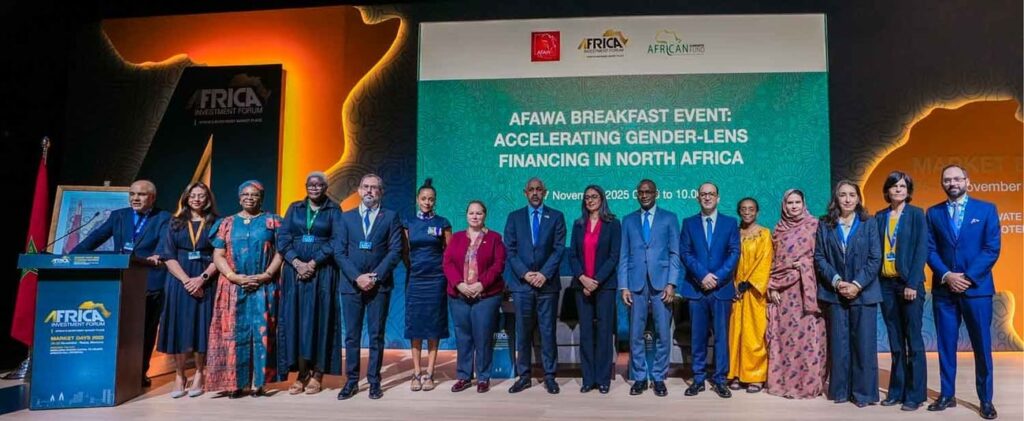
AFAWA Calls for Bold Action to Close the Gender Financing Gap in North Africa
Senior bankers, policymakers, development finance leaders and women entrepreneurs convened in Rabat for a high-level AFAWA breakfast session aimed at accelerating gender-lens financing across North Africa. The event took place during the Africa Investment Forum (AIF) Market Days and focused on dismantling persistent barriers to finance for women-led businesses.
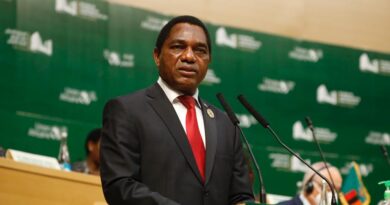
Morocco’s Minister of Economy and Finance, Nadia Fettah, opened the session with a firm call for action, stressing that women have long demonstrated their capability. “Women have nothing left to prove. They have already done their part of the work. It is up to the ecosystem to recognise that the talent is there, that the innovation is there, that the desire is there,” she said. Promoting women’s entrepreneurship, she added, is not merely redressing inequality but “amplifying the future, growth and ambition of our continent.”
Hosted by the African Development Bank Group’s Affirmative Finance Action for Women in Africa (AFAWA) initiative, together with the African Guarantee Fund (AGF), the forum addressed a key barrier: a perception gap within financial institutions. Although data shows that women entrepreneurs are typically low-risk and deliver strong returns, only 11% of women-owned businesses in Morocco receive formal financing, a statistic Minister Fettah attributed in part to entrenched biases.
African Development Bank President Dr Sidi Ould Tah reaffirmed the Bank’s commitment to expanding gender-responsive financing. “The African Development Bank Group, under my direction, will continue to accord paramount importance to this initiative,” he said, pledging to move guarantee mechanisms closer to women entrepreneurs and improve access to capital without collateral.
AGF Group CEO Jules Ngankam underlined the momentum behind the AFAWA Guarantee for Growth (G4G) programme. Since 2021, G4G has worked with over 100 financial institutions, unlocking $800 million for 12,000 women entrepreneurs, with the long-term goal of disbursing $3 billion. AFAWA aims to mobilise $5 billion for women-led enterprises continent-wide, of which $2.8 billion has been approved and $1.3 billion disbursed.
A panel discussion explored barriers from both the supply and demand side. Experts noted that while banks often overestimate the risks associated with women-led businesses, many entrepreneurs also face challenges linked to informality, such as incomplete financial records. Panellists stressed the need to tackle unconscious bias in lending decisions and to strengthen capacity-building initiatives.
Governments from Morocco and Mauritania announced new negotiations for guarantee schemes and renewed commitments to expand financing for women-led SMEs.
The session also spotlighted the rise of gender bonds in Africa as a powerful investment vehicle. Key examples included:
- Morocco’s landmark $20 million gender bond issued by CIH Bank in 2021 — the first on the continent;
- Equity Bank’s $32 million issuance, the first in sub-Saharan Africa;
- Ecobank’s $16 million issuance in West Africa.
All three were oversubscribed, prompting speakers to urge participants to make clear commitments to gender bond investments ahead of the next AIF.
The 2025 Africa Investment Forum Market Days, held under the theme “Bridging the Gap: Mobilising Private Capital to Unlock Africa’s Full Potential”, continues this week with sessions focused on deepening investment opportunities across the continent.