Low Productivity, Poor Infrastructure and Limited Finance Among Key Drivers of Poverty in Zambia – Finance Minister
Poverty in Zambia is shaped by a complex combination of factors, including low agricultural productivity, weak infrastructure, limited access to finance, and human capital challenges, Finance Minister Dr. Situmbeko Musokotwane told Parliament.
Responding to a question from Mr. Chinga Miyutu, MP for Kalabo Central, Dr. Musokotwane emphasised that poverty is multidimensional and requires coordinated action across sectors.
Highlighting agriculture, the Minister noted that many households depend on small-scale farming yet struggle with low yields, often producing less than two metric tonnes of maize per hectare.
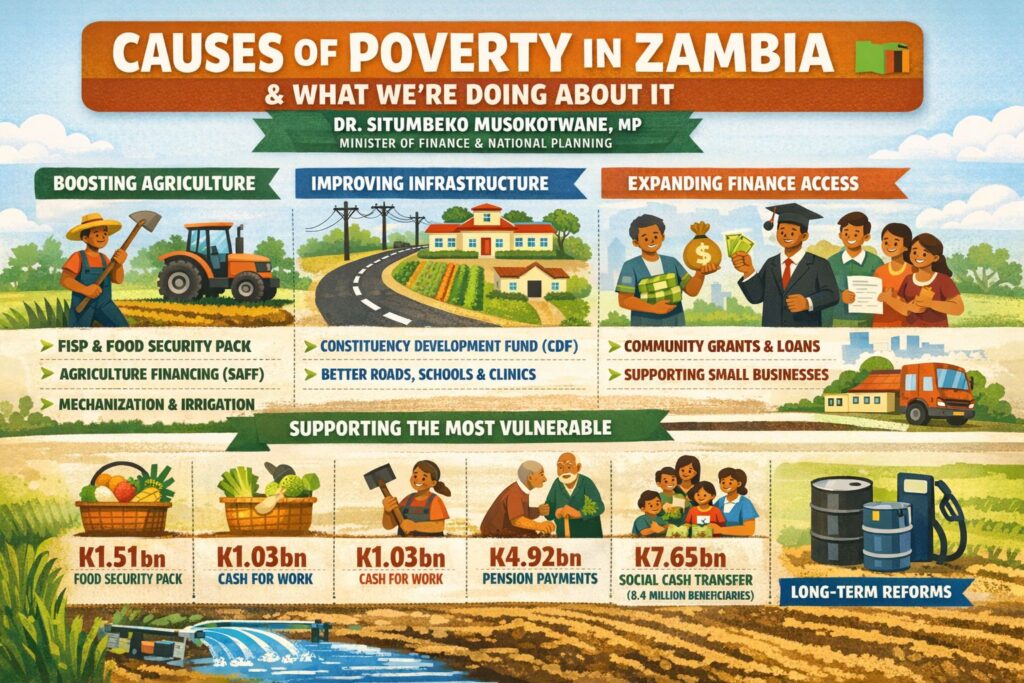
To tackle this, the Government has expanded programmes such as the Farmer Input Support Programme (FISP) and the Food Security Pack, and has enhanced access to agricultural finance through the Sustainable Agriculture Financing Facility (SAFF).
Dr. Musokotwane also identified poor infrastructure, including inadequate roads, unreliable electricity, and limited access to health and education services, as a significant barrier to livelihoods. Strengthened Constituency Development Fund (CDF) initiatives are addressing these challenges by supporting local infrastructure, improving service delivery, and providing grants and loans to communities.
Limited access to credit, particularly in rural areas and for micro and small enterprises, was cited as another driver of poverty. Through initiatives such as SAFF and community-level CDF funding, the Government is helping households and businesses secure the finance needed to invest and grow.
The Minister further highlighted demographic and human capital issues, including large household sizes, low education levels, and skills gaps. In response, the Government has reinstated bursaries for university students, implemented the Free Education Policy, and expanded social protection programmes to support vulnerable households.
For 2026, social protection allocations total K15.7 billion, including K7.65 billion for the social cash transfer programme, K4.92 billion for pensions, K1.51 billion for the Food Security Pack, and K1.03 billion for Cash for Work. These measures aim to safeguard households while broader economic reforms are implemented.
Looking ahead, Dr. Musokotwane said long-term reforms such as improving fuel supply efficiency, investing in irrigation and mechanisation, and supporting mining and other productive sectors would help raise incomes, boost food security, and create sustainable employment.
“The sustainable way to reduce poverty is to grow the economy, expand income opportunities, and protect the vulnerable during the transition,” the Minister concluded, reaffirming the Government’s commitment under the leadership of President Hakainde Hichilema.