
AfDB Promotes Climate-Smart Farming in Africa
The African Development Bank Group (AfDB) has reaffirmed its commitment to strengthening Africa’s food systems by promoting climate-smart agriculture, following a continental forum that brought together experts, policymakers and private sector players from across Africa and beyond.
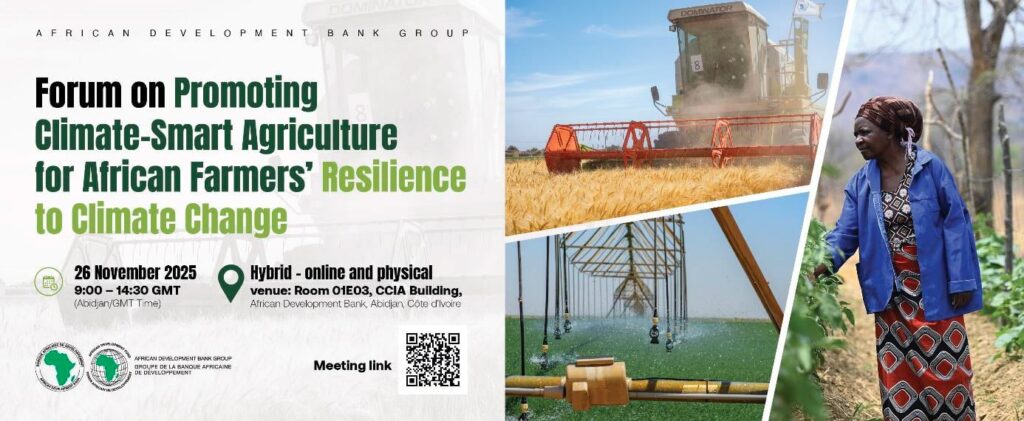
The online Forum on Promoting Climate-Smart Agriculture for African Farmers’ Resilience to Climate Change attracted about 390 participants from 34 African countries and 10 non-regional countries. It focused on scaling proven agricultural technologies, fostering partnerships and improving access to information for farmers facing the growing impacts of climate change.
Africa remains highly vulnerable to climate shocks, with projections indicating that production of staple crops such as maize and wheat could decline by up to 20 percent by 2050 if adaptation measures are not accelerated. Agriculture employs more than half of sub-Saharan Africa’s workforce, making climate resilience critical to livelihoods and food security.
The AfDB highlighted climate-smart agriculture as a key solution to these challenges. Research shows that simple practices, such as adjusting planting dates and adopting climate-resilient crop varieties, could not only prevent yield losses but increase production by up to 13 percent in parts of West Africa.
Central to the Bank’s efforts is the Technologies for African Agricultural Transformation (TAAT) programme, which deploys high-impact innovations such as drought-resistant and heat-tolerant seeds. Since its launch, TAAT has reached more than 13 million farmers, increasing crop production by an estimated 25 million tonnes across the continent.
In Nigeria, for example, the programme has supported a dramatic expansion in wheat production through improved seed distribution and farmer training, contributing to higher yields and increased food output.
The forum also emphasised the vital role of farmer organisations and the private sector in scaling climate-smart technologies. Cooperatives, agribusinesses and telecom companies are increasingly bundling inputs with advisory services, credit and climate information, helping farmers make informed decisions and reduce losses.
Participants noted that many farmers are already benefiting from African Development Bank-backed technologies—such as climate-resilient seeds, improved livestock breeds and water-saving irrigation systems—often without realising they originate from Bank-supported initiatives implemented through governments and private partners.
The Bank further highlighted the impact of the Africa Fertilizer Financing Mechanism (AFFM), which uses innovative financing and credit guarantees to improve access to fertiliser and agricultural inputs. Between 2019 and 2025, AFFM-supported projects enabled the distribution of more than 145,000 metric tonnes of fertiliser, benefiting nearly one million smallholder farmers, including a significant proportion of women.
The forum concluded with a call for stronger collaboration, better information sharing and sustained investment to ensure climate-smart agriculture becomes the norm rather than the exception across Africa.