
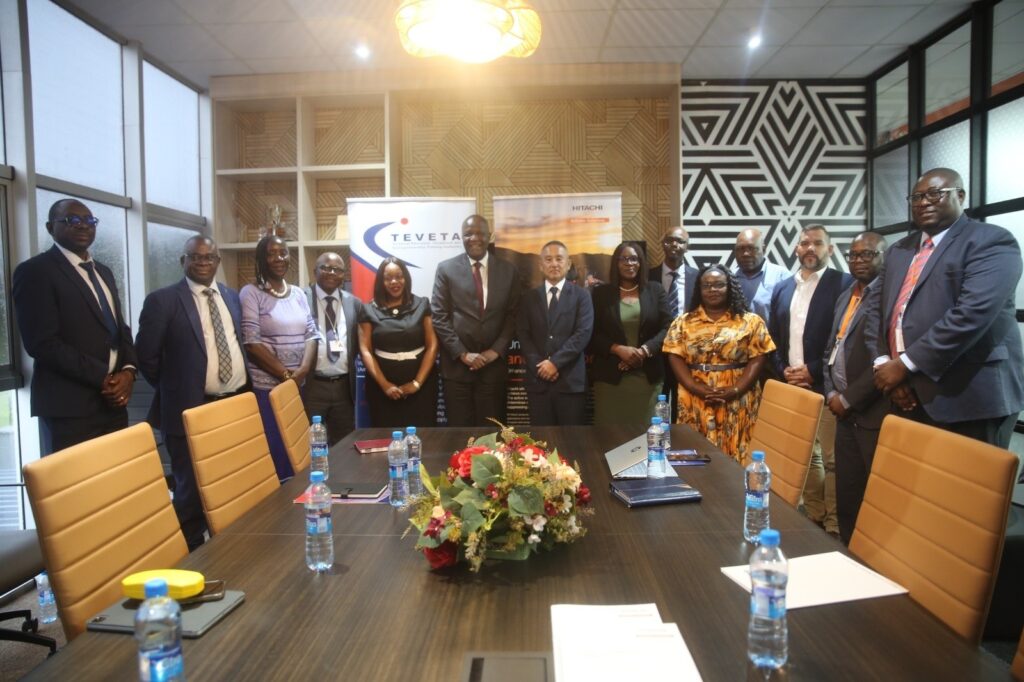
TEVETA and Hitachi Partnership to Transform Zambia’s Skills and Industrial Growth
Zambia achieved a major milestone in advancing industry-aligned skills development as the Technical Education, Vocational and Entrepreneurship Training Authority (TEVETA) formalised a strategic partnership with Hitachi Construction Zambia through the signing of a Memorandum of Understanding (MoU) at the Hitachi Head Office in Lusaka.
The ceremony was officiated by the Guest of Honour, Felix C. Mutati, who praised the strengthened collaboration between the private sector and Government through the Ministry of Technology and Science. He emphasised that partnerships of this nature are critical for aligning skills development with industrial growth and national economic transformation.
Speaking at the event, Hitachi Construction Zambia President Nobuhiko Saito expressed gratitude to the Federation of Employers, the TEVETA Board and Management, and the Ministry of Technology and Science for supporting the partnership.
He described the MoU as a major milestone that formalises long-standing cooperation and reinforces Hitachi’s commitment to Zambia’s industrial future.
Mr Saito noted that as the construction and mining sectors rapidly evolve through technological advancement, automation, and increasing demand for highly trained technicians, structured apprenticeships and industry-aligned curriculum development have become essential. The partnership will expand practical training opportunities for young Zambians, equipping them with globally competitive competencies.
The TEVETA Board Chairperson, Ngoza Nkwabilo Chibesakunda, commended Minister Mutati for his efforts in reforming the TEVET curriculum to meet modern industry demands.
She highlighted Government’s drive to integrate advanced technologies, artificial intelligence, and digital systems into training programmes to ensure graduates acquire relevant, future-ready skills.
Ms Chibesakunda also applauded Hitachi Construction Zambia for providing learners with hands-on exposure to modern tools, equipment, and best industry practices, enhancing competence, confidence, and employability.
She emphasised that the MoU strengthens collaboration across the Technical, Education, Entrepreneurship and Vocational Training ecosystem, particularly in supporting Zambia’s mining sector.
The MoU aligns with TEVETA’s Strategic Plan, prioritising strong industrial partnerships, economic transformation through skills development, increased workforce employability, expansion of Competency-Based Education and Training, and curriculum modernisation.
TEVETA Director General Cleophas Takaiza described the MoU as a transition from goodwill to a structured, results-oriented partnership focused on practical technical training aligned with industry needs.
As part of immediate implementation, 85 interns from TEVET institutions, including Northern Technical College (NORTEC), will commence industrial training at Hitachi by April 2026. In the long term, TEVETA, through the Ministry of Technology and Science, plans to transform the Kitwe Vocational Training Centre (KVTC) into a modernised training hub with industrial support from Hitachi.
Key focus areas of modernisation include joint curriculum review, integration of Internet of Things technologies, automation and advanced hydraulics, equipment diagnostics, digital monitoring systems, and smart technologies for industrial efficiency. This ensures graduates are employable locally and competitive globally.
In his keynote remarks, Minister Mutati described the occasion as a significant step towards Zambia’s target of producing three million metric tonnes of copper by 2030.
He noted that Government reforms and over US$2 billion in secured investment will drive mining sector growth, with skilled human capital being essential to achieving these outcomes.
The Minister highlighted Government initiatives to create a conducive business environment, including expanded 5G connectivity to drive digital transformation in the mining sector.
He emphasised that hands-on, industry-based training with at least 80 percent practical exposure is key to meeting industrial demands and achieving mutual benefits for both industry and the nation.
Minister Mutati concluded by thanking Hitachi Construction Zambia for partnering with TEVETA, noting that the collaboration will significantly contribute to skills empowerment, industrial growth, and sustainable national development.
He also toured the ultra-modern workshop and classroom facilities where training activities will be conducted.