China Grants Zambia K277 Million to Support Economic Growth
The Government of Zambia and the Government of the People’s Republic of China have signed a grant agreement worth RMB 100 million (approximately K277 million), reaffirming their long-standing partnership and shared commitment to advancing development for the benefit of citizens.
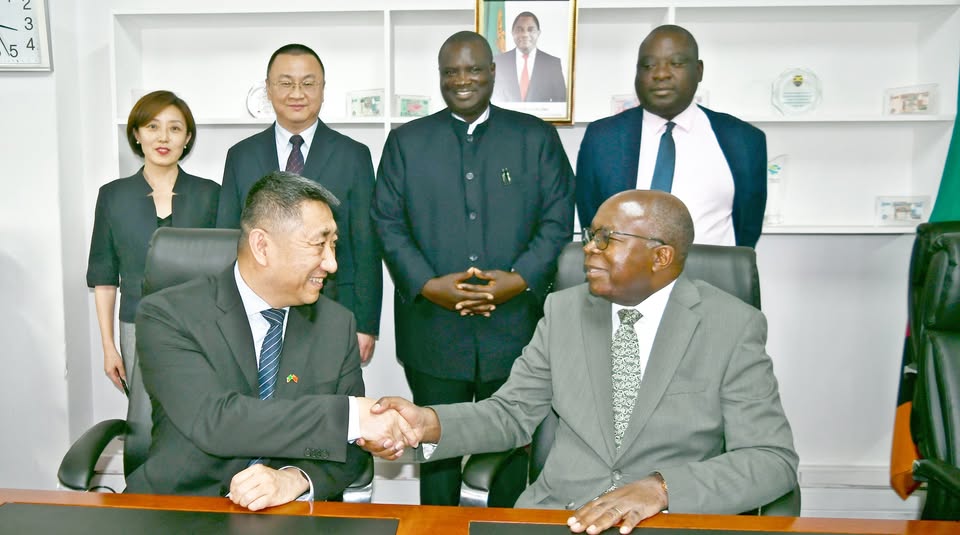
The agreement was signed in Lusaka by Minister of Finance and National Planning, Situmbeko Musokotwane, and China’s Ambassador to Zambia, Han Jing, during a ceremony attended by senior government officials and representatives from the Chinese Embassy.
Speaking at the event, Ambassador Jing described the agreement as a practical step towards implementing commitments made by the leadership of both countries. He noted that under the guidance of Chinese President Xi Jinping and Zambian President Hakainde Hichilema, bilateral relations have reached a new level as a comprehensive strategic partnership.
He said the grant reflects China’s continued support for Zambia’s economic and social development, particularly in areas aligned with national priorities and those that directly benefit citizens.
“The grant provided by the Chinese Government is intended to assist our Zambian brothers and sisters to implement projects that are most needed,” Ambassador Jing said.
He added that China’s cooperation with Zambia has contributed to key national projects, including Kenneth Kaunda International Airport, Levy Mwanawasa University Teaching Hospital, Mulungushi International Conference Centre, and Mulungushi Textiles.
Ambassador Jing further highlighted China’s support through scholarships, training programmes, and capacity-building initiatives targeting Zambian professionals, particularly young people.
In his remarks, Dr Musokotwane described the signing as an important milestone in Zambia–China relations and a demonstration of China’s responsiveness to Zambia’s development needs.
“It is a significant moment because we have just signed a grant agreement between our two countries. On behalf of the people of Zambia, we are grateful,” he said.
The Minister said government would move swiftly to identify priority projects to be financed under the grant, emphasising the importance of translating agreements into tangible development outcomes.
“All I can do now is to urge that we quickly identify the projects that are going to benefit from this grant so that we move quickly and get them done,” he said.
Dr Musokotwane noted that the agreement reflects a broader model of cooperation between Zambia and China, where high-level engagements lead to concrete implementation.
He also pointed to progress in key sectors such as energy, mining, fertiliser production and textiles, where ongoing reforms and partnerships are attracting investment and creating jobs.
The Minister cited increased investment in solar energy projects, developments in the mining sector, and the recent revival of Mulungushi Textiles as examples of how cooperation is delivering practical results.
He added that Zambia continues to draw lessons from China’s development experience, particularly in areas such as economic reform, productivity and investment-led growth.
The grant agreement further strengthens Zambia’s efforts to mobilise development financing, expand productive capacity and advance priorities in infrastructure, industrialisation and social services.
Government has since reaffirmed its commitment to ensuring that the funds are utilised transparently and directed towards projects that will have a meaningful impact on the lives of Zambians.