Ending Female Genital Mutilation/Cutting Is Justice, Not Charity – Advocates
Global health and human rights advocates have renewed calls for urgent action to end female genital mutilation/cutting (FGM/C), stressing that eliminating the practice is a matter of justice, dignity, and human rights rather than charity.
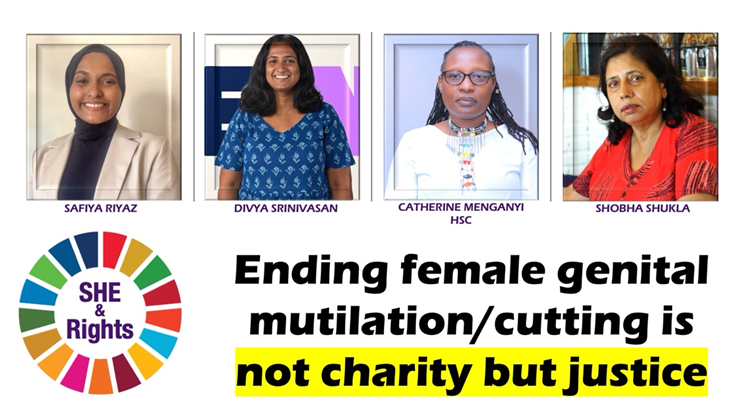
Speaking during a SHE & Rights session organised by multiple global and regional partners, Catherine Menganyi, a nurse-epidemiologist and survivor of FGM/C, shared her personal experience of the practice and its lasting physical and psychosocial impact.
“My journey did not begin in an office. It began where the shoe hurts most,” said Menganyi, who is also Co-Founder and Chapter Lead of Women in Global Health Kenya. She explained that she was subjected to FGM/C as a young girl and continues to live with the trauma.
However, she said this experience has strengthened her resolve to protect other girls from undergoing the practice.
“As a survivor and as a health professional, I know the harm FGM/C causes. Ending it is about ensuring that every girl grows up whole, safe, educated, and free from violence,” she said.
Highlighting the severe health consequences, Safiya Riyaz, Programme Officer at the Asian-Pacific Resource and Research Centre for Women (ARROW) and Coordinator of the Asia Network to End FGM/C, warned that the practice has no medical justification.
“FGM/C includes all procedures involving partial or total removal of the external female genitalia for non-medical reasons. Regardless of the terminology used, it is internationally recognised as a grave violation of human and child rights and a form of gender-based violence,” Riyaz said.
She added that even when FGM/C is carried out in clinical settings, it violates medical ethics. The World Health Organization and other global medical bodies have strongly condemned the medicalisation of FGM/C, emphasising that it offers no health benefits and instead legitimises a harmful practice.
The session also examined how harmful social norms, misconceptions around “purity”, and the desire to control women’s sexuality continue to sustain FGM/C, particularly in parts of Asia and Africa.
Advocates stressed the importance of community-led and community-owned solutions. Menganyi noted that in some communities, girls are forced to flee their homes to escape the risk of being cut, turning places of safety into sites of fear.
“We must invest in solutions that come from affected communities themselves. They understand the problem best and are best placed to develop sustainable and culturally relevant responses,” she said.
Participants further emphasised that FGM/C cannot be addressed in isolation. It is part of a wider system of violence and discrimination against women and girls, and efforts to end it must be linked to broader struggles for gender equality, education, health, and peace.
Delivering closing remarks, Shobha Shukla, feminist leader and Managing Editor of Citizen News Service (CNS), expressed concern over slow progress despite global commitments.
She recalled that world leaders pledged at the 2015 UN General Assembly to eliminate FGM/C by 2030 under Sustainable Development Goal 5.3. However, the number of affected women and girls has risen from 200 million in 2016 to over 230 million in 2024, an increase of 15 per cent.
Shukla noted that FGM/C has been documented in at least 94 countries worldwide, including 13 in South and Southeast Asia, yet only a limited number have specific laws banning the practice. She highlighted the Universal Periodic Review (UPR) as a critical accountability mechanism for monitoring state action on human rights, including FGM/C.
The session also drew attention to a new report by Equality Now, which examines how strategic litigation is being used globally to strengthen laws, close legal gaps, and protect survivors. According to the report, courts are becoming a key frontline in efforts to end FGM/C, although prosecutions remain rare and access to justice limited.
“Ending female genital mutilation/cutting is not charity. It is justice,” Menganyi concluded, urging governments, communities, and institutions to accelerate action to protect the rights, health, and dignity of all women and girls.