
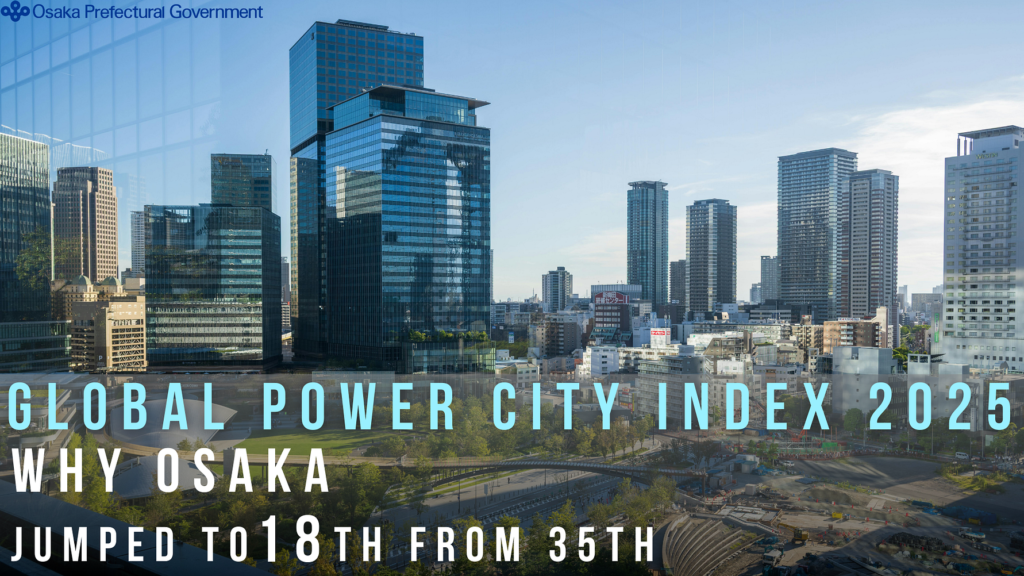
Osaka Rises to 18th in Global Power City Index 2025
Osaka Prefecture has recorded the biggest climb in the Global Power City Index (GPCI) 2025, rising from 35th to 18th place among 48 leading cities worldwide, according to the Mori Memorial Foundation’s Institute for Urban Strategies.
The sharp improvement highlights Osaka’s growing status as a competitive global city, driven by stronger international engagement, rising tourism and improved urban livability, particularly in the post-Expo period.
One of the most notable gains was in Cultural Interaction, where Osaka moved from 23rd to 13th place — the largest rise in this category among all ranked cities. The improvement was supported by increased foreign visitor arrivals, a higher number of international conferences and expanded cultural events, reflecting the city’s expanding global presence.
Osaka also recorded significant progress in other key areas. Its economic ranking improved from 38th to 33rd, tying with Dubai for one of the largest gains, while livability from a resident perspective rose from 15th to 8th. Shorter commuting times, alongside a high concentration of retail outlets and restaurants, contributed to the city’s appeal as a place to live and work.
The Global Power City Index assesses cities across six dimensions: economy, research and development, cultural interaction, livability, environment and accessibility. In the 2025 edition, Osaka improved its position in all six categories, underlining its growing competitiveness and international momentum.
Osaka’s rising global profile has been reinforced by the Osaka–Kansai Expo, which attracted approximately 29 million visitors from 158 countries and regions, serving as a major platform for international exchange. Inbound tourism also reached a record high in 2025, with an estimated 17.6 million foreign visitors, according to the Osaka Convention and Tourism Bureau.
Economically, Osaka continues to show resilience, with a nominal GDP of ¥44.5 trillion and growth of 4.3 per cent, marking three consecutive years of positive expansion. Looking ahead, the Prefecture is developing a long-term strategy titled “Beyond EXPO 2025: Toward Osaka’s Post-Expo Future”, aimed at increasing nominal GDP to ¥80 trillion by the 2040s. The final plan is expected to be completed by March 2026.
Strong accessibility further enhances Osaka’s appeal. The city is within 30 minutes of Kyoto and Kobe by train, around 2.5 hours from Tokyo via the Shinkansen, and is served by approximately 240 domestic flights daily. International connectivity is equally robust, with more than 1,550 weekly international flights linking Osaka to 82 cities worldwide.
With its expanding global reach, strong infrastructure and supportive public policies, Osaka is increasingly positioning itself as a city of opportunity for startups, investors and global entrepreneurs seeking a strategic base in Asia.
Learn more about Osaka’s startup ecosystem and support programs here: https://www.pref.osaka.lg.jp/o020050/renkei/openosaka/index.html#assi