US Ambassador Calls for Reform of Foreign Aid to Fight Corruption
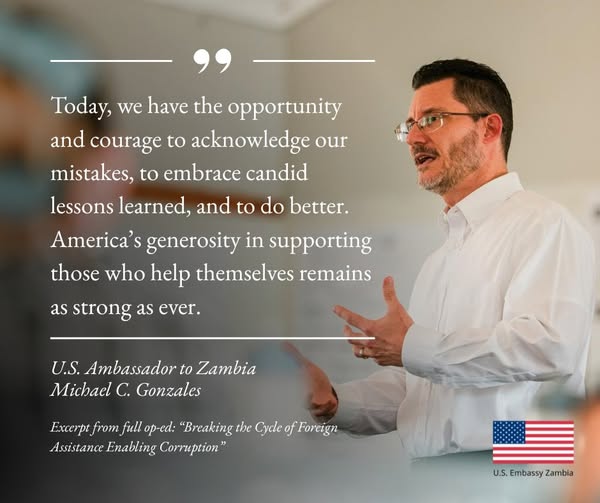
The United States must rethink its approach to foreign assistance, with greater emphasis on accountability and systemic reforms, according to Ambassador Michael C. Gonzales, the US envoy to Zambia.
In an article published by the State Department, Ambassador Gonzales warned that decades of aid have often fuelled dependence and corruption, rather than promoting sustainable development.
He noted that while the US has provided over $200 billion in assistance to Africa since 1991, the continent loses an estimated $88 billion annually through corruption, money laundering, and tax evasion.
“The donor cannot want development more than the recipient,” Gonzales wrote, highlighting cases from Malawi’s “Cashgate” scandal to governance failures in Bangladesh and South Sudan. “By backfilling needs recklessly created by bad governance, we have underwritten government corruption.”
He argued that US foreign aid should be treated as a tool to advance American diplomacy, security, and prosperity, rather than as charity. This, he said, requires host-government buy-in, clear performance-based funding, and reforms that foster private sector growth.
Ambassador Gonzales cited best practices from the Millennium Challenge Corporation, including co-financing by recipient governments, binding contracts with legislated commitments, and technical support designed around targeted outcomes.
He stressed that aid must focus on catalysing real economic development and closing avenues for corruption, while ensuring tangible benefits for both Americans and citizens of developing nations.
“By restructuring our approach and engaging countries based on national interest, we can curb corruption, deliver systematic growth, and create a more secure and prosperous world,” Gonzales said.
Ambassador Gonzales has served across Africa and Asia, and also represents the United States to the Common Market for Eastern and Southern Africa (COMESA).