
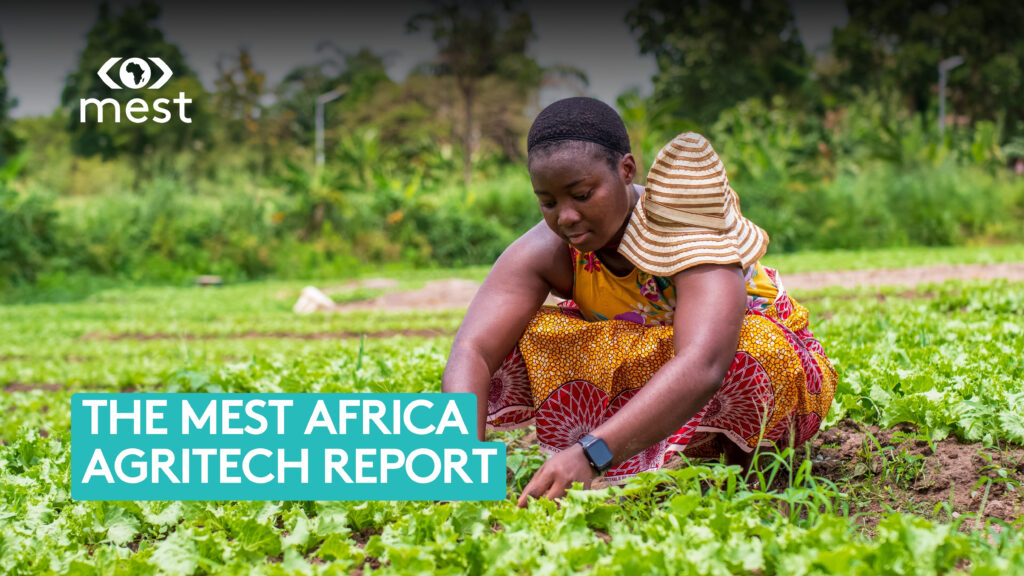
MEST Africa Unveils AgriTech Report on West Africa’s Farming Future
The Meltwater Entrepreneurial School of Technology (MEST Africa) has launched a new AgriTech report charting the technologies, startups and investment opportunities shaping the future of agriculture across West Africa.
Unveiled as part of the 2024 edition of the MEST Africa Challenge (MAC), and developed in partnership with the Norwegian Embassy in Accra, the report examines how locally driven innovation is helping farmers overcome long-standing challenges such as post-harvest losses, limited market access and gaps in agricultural financing.
According to the report, West African AgriTech innovators are increasingly deploying mobile platforms, artificial intelligence (AI), the Internet of Things (IoT) and solar-powered solutions to improve productivity and resilience across agricultural value chains.
“Agriculture has always been the backbone of West Africa’s economy, but we are now witnessing a new era defined by technology, local ingenuity and scalable innovation,” said Ashwin Ravichandran, Portfolio Advisor and Lead for the MEST Africa Challenge. “This report captures that shift and underscores the need for stronger collaboration between entrepreneurs, investors and policymakers.”
The study draws on data and case studies from five key markets—Ghana, Nigeria, Côte d’Ivoire, Senegal and Benin—and profiles more than 40 AgriTech startups delivering measurable impact. Among them is Ghana’s SAYeTECH, winner of the 2024 MEST Africa Challenge, which produces locally suited mechanisation tools, and Nigeria’s ColdHubs, whose solar-powered cold storage facilities have helped save over 40,000 tonnes of fresh produce from spoilage.
Despite the growing momentum, the report notes that AgriTech currently receives only around 4 per cent of total venture capital investment in Africa. This, it argues, presents a significant opportunity for investors seeking to support solutions that advance food security, rural livelihoods and inclusive economic growth.
Ecosystem enablers such as MEST Africa, Kosmos Innovation Center (KIC) and CcHUB continue to play a critical role by nurturing talent and providing early-stage funding. However, the report stresses that scaling impact will require greater investment in data, infrastructure and human capital.
“Our ambition is not just to showcase innovation, but to catalyse collaboration,” Ravichandran added. “With the right investments, Africa’s AgriTech ecosystem can grow sustainably and ensure that technology truly serves the farmer.”
Since its establishment in 2008, MEST Africa has trained and supported more than 2,000 entrepreneurs and invested in over 90 startups. The MEST Africa Challenge remains its flagship pan-African pitch competition, aimed at identifying and scaling high-potential technology ventures.
The full report is available for download via APO Group.