
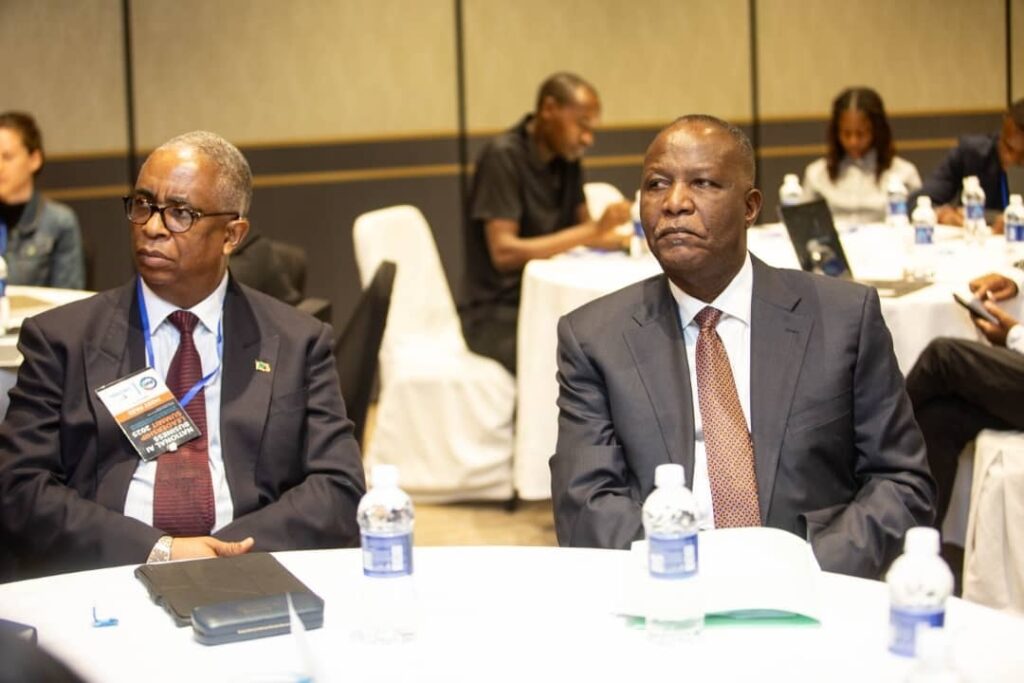
Zambia Commits to Intelligent Growth at 2025 AI Leadership Summit
Zambia has taken a decisive step towards embracing artificial intelligence as a driver of national development at the 2025 National AI Business Leadership Summit, held at the Intercontinental Hotel in Lusaka.
The event, hosted under the theme “Leveraging Artificial Intelligence to Transform Zambia’s Industries”, brought together innovators, business leaders, policymakers, technologists and development partners committed to shaping the country’s digital future.
Speakers at the summit highlighted that AI is no longer a distant idea but a transformative force already reshaping agriculture, mining, manufacturing, finance, education, health and public administration. The gathering provided a strategic platform for national dialogue and collaboration as Zambia positions itself to build an inclusive, competitive and intelligent economy.
Minister of Technology and Science, Hon. Felix C. Mutati MP, highlighted the complementarity between human intelligence and artificial intelligence, emphasising that while machines cannot match human intuition, AI remains the most influential technology of the era.
He noted that AI is projected to contribute nearly US$18 trillion to the global economy by 2030 and insisted that Zambia must position itself to benefit from these shifts. He further pointed out that Zambia’s early publication of its National AI Strategy places it among the leading African nations in shaping a structured approach to AI development.
The Minister stated that AI is already delivering tangible results in Zambia, including its role in the discovery of the largest copper deposit in a century at the Ming’omba Mine through AI-assisted exploration. He also emphasised that pilot projects in health and education are demonstrating improved service delivery, wider reach and reduced operational costs.
He reiterated that AI will not eliminate jobs but will transform them, creating new opportunities in much the same way previous industrial revolutions have done.
President of the Lusaka Chamber of Commerce and Industry, Mr Alexander Lawrence, described AI as central to Lusaka’s ambition of becoming a multi-sectoral trade and investment hub. He commended the Ministry of Technology and Science and the country’s innovators for championing a platform that aligns industry with national priorities.
Mr Lawrence explained that AI has the potential to reshape commerce, production and competitiveness, particularly when integrated into logistics, trade facilitation, manufacturing and financial services. He announced the Chamber’s commitment to establish the Lusaka AI for Trade and Investment Task Force and to introduce an SME Digital Adoption Programme aimed at encouraging early and widespread innovation uptake.
Chief Executive Officer of Zambian Cloud Programmers, Mr Clement Kamanda, stressed that AI is already redefining global value creation. He observed that the world’s most valuable companies are now technology-driven, reinforcing the notion that intelligence, rather than land or machinery, is the new foundation of economic power. He highlighted Zambia’s advantages, including a youthful population, a reform-oriented government and a growing pool of ambitious innovators.
However, he pointed out that many young people still lack practical industry exposure and that businesses frequently import digital systems that could be developed locally, resulting in lost economic opportunities.
Mr Kamanda emphasised that the future of work will be shaped by AI-driven transformation. He noted that global forecasts suggest that while millions of jobs may be displaced by 2030, even more will be created, and Zambia must therefore identify the skills required for these emerging roles.
He urged businesses to support local innovation, encouraged academia to modernise training programmes and called on government and development partners to strengthen ethical governance, regulatory clarity and innovation-friendly environments. He also advised young people that understanding AI will be crucial to remaining competitive in the evolving labour market.
The summit concluded with a unified message: artificial intelligence represents a national opportunity which Zambia must embrace boldly and collaboratively. With continued investment in digital infrastructure, expanded skills development, strengthened public–private partnerships and a clear national vision, Zambia is positioning itself as a future leader in intelligent technologies.