
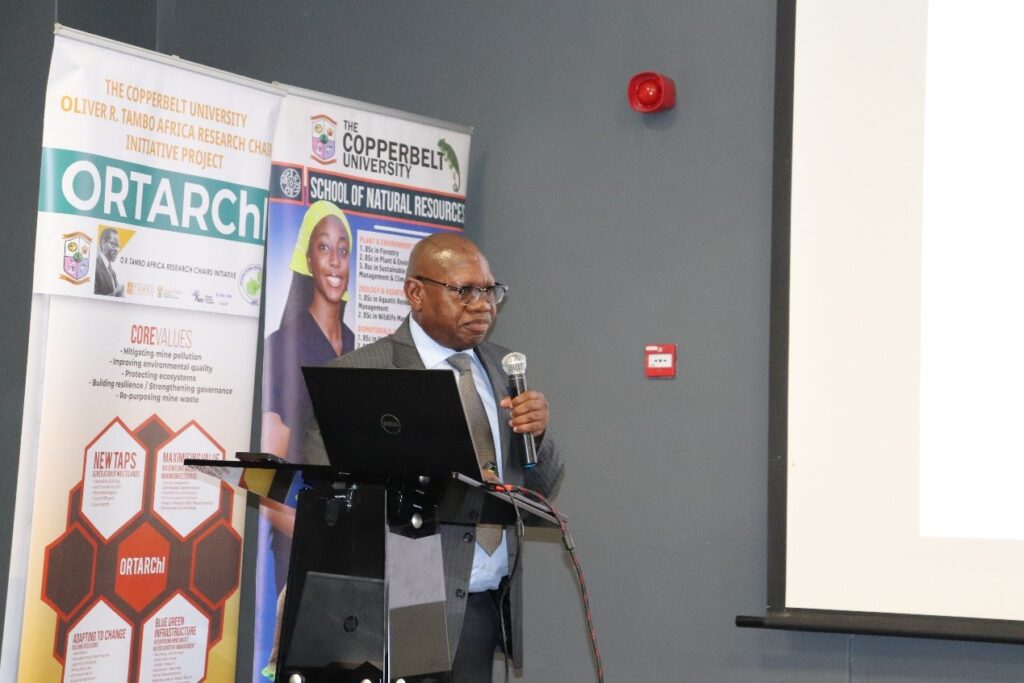
“Zambia’s New Poverty Is Mismatched Education, Not Money” – Professor Chinsembu
Poverty in Zambia is no longer solely defined by lack of income, but by the absence of the right type of higher education, Higher Education Authority (HEA) Director-General, Professor Kazhila C. Chinsembu, has declared.
Professor Chinsembu made the remarks during his Keynote Address on the final day of the 2nd National Research and Innovation Symposium, held from 2–5 December at the Garden Court Hotel in Kitwe. The event is hosted by Copperbelt University (CBU) in partnership with the Ministry of Education.
“The starting point is higher education,” Professor Chinsembu emphasised. “It is the strategic lever that can catapult and sustain Zambia’s competitiveness in the global economy. Nothing else performs this role at scale.”
He highlighted that His Excellency, President Hakainde Hichilema, has directed that education, and higher education in particular, should now be classified as an economic sector.
The Director-General urged a complete transformation of the higher education system, calling for the deconstruction of outdated models and the removal of archaic or irrelevant curricula.
“Transformation must have a strategic intent. Unless we develop a high-risk appetite, reform of higher education will not succeed. It cannot be random or aimless,” he said.
Professor Chinsembu’s keynote, titled ‘The Best Economic Policy Is Higher Education: Transforming Higher Education to Transform the Economy’, stressed the vital role universities play in driving medical breakthroughs, technological innovation, and intellectual leadership.
“The economy of knowledge versus the economy of goods and services, intellectual property versus physical property, has one goal: to convert knowledge into goods and services,” he explained.
However, he lamented that higher education in Zambia has experienced diminishing returns, with some universities prioritising comfort and status over academic excellence. He warned that without a strong focus on quality, relevance, and accountability, Zambia’s development ambitions would remain out of reach.
Professor Chinsembu also highlighted the importance of retaining a critical mass of skilled academic staff, noting that quality graduates can only emerge from institutions where lecturers are supported, valued, and properly equipped.
“In 1997, the Bobby Bwalya Commission of Inquiry observed that without attention to the retention and motivation of academic staff, the problem of quality in core university functions will persist,” he said.
The symposium’s Guest of Honour was the Honourable Minister of Education, Mr. Douglas Munsaka Syakalima, MP, who was represented by the Director – University Education, Mr. Brian Makufele.