SADC Steps Up Action Against Cross-Border Mineral Crime
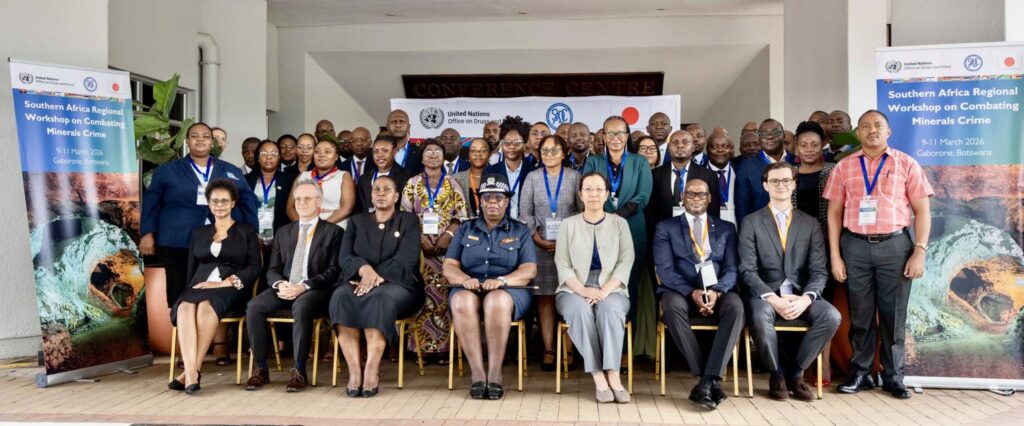
Law enforcement and regulatory authorities from across Southern Africa convened at the Avani Hotel in Gaborone from 9 to 11 March for the Southern Africa Regional Workshop on Combating Mineral Crimes.
Organised by the United Nations Office on Drugs and Crime (UNODC) in partnership with the SADC Secretariat and supported by the Government of Japan, the workshop sought to tackle the growing threat of organised criminal activity in the region’s critical mineral sector.
The three-day event brought together a broad spectrum of stakeholders, including police services, anti-corruption agencies, environmental enforcement authorities, financial intelligence units, mining regulators, and prosecutors. Regional and international partners, such as INTERPOL, also participated.
Southern Africa is home to some of the world’s largest deposits of critical minerals, including lithium, cobalt, copper, nickel, graphite, and rare earth elements. These resources are essential for the global green energy transition, powering technologies such as electric vehicles, solar panels, and advanced batteries.
However, the region’s mineral wealth has become a target for sophisticated criminal networks engaging in illegal mining, smuggling, tax evasion, corruption, and money laundering, depriving governments of revenues and threatening economic and environmental stability.
The workshop aimed to strengthen enforcement capabilities, address vulnerabilities across mineral supply chains, and enhance collaboration between governments, industry, and financial actors.
Opening the event, Guest of Honour Ms Dinah Marathe, National Commissioner of the Botswana Police Service, highlighted the link between illicit mining, corruption, and money laundering, stressing that “mineral crime constitutes a regional threat requiring a unified and multi-sectoral response.”
She urged sustained investment in law enforcement training and advanced technologies to combat increasingly complex criminal networks.
Ms Satomi Ishihara, First Secretary at the Embassy of Japan, reaffirmed Japan’s commitment to supporting the SADC region through initiatives such as the RISE Partnership and TICAD-9, emphasising the importance of protecting Africa’s mineral wealth to promote inclusive prosperity.
UNODC Representative Mr Giovanni Broussard called for enhanced regional and international cooperation, harmonised legal frameworks, and strengthened capacity for law enforcement and justice institutions to tackle complex minerals crime networks.
Ms Kealaboga Moruti, representing the Director of the Organ on Politics, Defence and Security Affairs, warned that mineral crimes undermine regional development, noting that “national efforts alone are insufficient” as criminal syndicates operate across borders. She stressed the need for actionable regional collaboration and practical measures to counter transnational criminal activity.
Key discussions focused on improving intelligence sharing, supply chain integrity through traceability and due diligence, and strengthening partnerships with industry and financial institutions to detect and report suspicious activities.
The workshop concluded with a set of concrete action points to be submitted to the Ministerial Committee of the Organ (MCO) for approval, laying the groundwork for coordinated regional implementation.