New $28m Project Targets Jobs and Recovery in Cabo Delgado
The Government of Mozambique, in partnership with the African Development Bank Group and the United Nations Development Programme, has launched a major initiative aimed at restoring livelihoods and promoting stability in the conflict-affected Cabo Delgado Province.
The Resilient Investment for Socio-Economic Empowerment, Peace and Security (RISE-PS) Project will target the districts of Palma District, Cabo Delgado and Ancuabe District, Cabo Delgado, where years of insecurity have disrupted economic activity and displaced thousands of residents.
The project is financed through a blended investment package worth US$28 million. Funding includes US$17 million from the African Development Bank’s Transition Support Facility, US$4.2 million from UNDP, US$2.4 million from the Government of Germany, US$3.1 million from private sector partners and US$1.3 million from the Government of Mozambique.
Implementation will be led by the Northern Integrated Development Agency with technical support from UNDP.
The programme is expected to directly benefit about 24,000 young people, half of whom are women, as well as more than 3,000 female-headed households and over 7,300 local enterprises. Indirectly, improved infrastructure and investment flows are expected to benefit the wider population of Cabo Delgado, estimated at 2.74 million people, and the broader northern region with around 11.6 million residents.
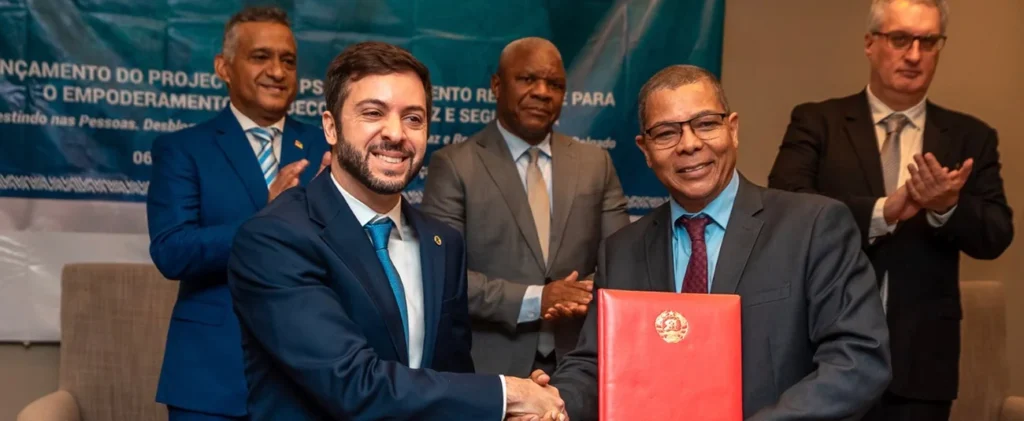
Speaking during the launch ceremony in Maputo on 6 March 2026, Salim Cripton Valá, Mozambique’s Minister of Planning and Development, said infrastructure development would play a key role in attracting businesses and creating employment opportunities.
“The establishment of relevant infrastructure is fundamental to attracting SMEs, stimulating private investment and generating employment opportunities for young people and women,” Valá said.
The project will support 108 private sector partnerships aimed at creating structured youth internship opportunities and providing technical and soft-skills training. It will also develop a climate-smart SME Village in Afungi designed to attract up to 100 micro, small and medium-sized enterprises.
Special focus will be placed on empowering young women in conflict-affected communities through vocational training, grants for women-led businesses, support for participation in priority value chains and initiatives promoting women’s leadership in community decision-making.
Rômulo Cunha Corrêa, Country Manager for the African Development Bank Group in Mozambique, said the project is designed to address the underlying causes of fragility in the region.
“The RISE-PS project is a timely and transformative intervention designed to address the complex drivers of fragility in northern Mozambique. By focusing on institutional capacity, resilient societies and private investment, we are supporting economic recovery and giving approximately 24,000 young people and women a reason to believe in their future,” he said.
Edo Stork, UNDP Resident Representative in Mozambique, said the initiative represents a shift from emergency stabilisation towards long-term development.
“UNDP is proud to support RISE-PS as a programme that strengthens local resilience, expands economic opportunities and ensures that peacebuilding underpins development,” Stork said.
On the sidelines of the launch, a high-level investment roundtable was held to accelerate development initiatives in northern Mozambique. Yero Baldeh, Director of the African Development Bank’s Transition States Coordination Office, said the initiative demonstrates the Bank’s commitment to mobilising private sector investment in fragile contexts.
He added that the Peace and Security Hub, being piloted under the RISE-PS project, could be replicated in other fragile regions across Africa to attract impact investment aimed at peacebuilding and resilience.
Ahead of the project launch, the African Development Bank, the Northern Integrated Development Agency and UNDP held a three-day technical workshop at the Ministry of Planning and Development to align partners on governance frameworks, environmental safeguards, procurement procedures and monitoring systems.
The partners say the initiative will play a crucial role in rebuilding livelihoods, strengthening local economies and supporting lasting peace in northern Mozambique.