Zambia–EU Engagement Promises Investment, Reform Support and Better Public Services
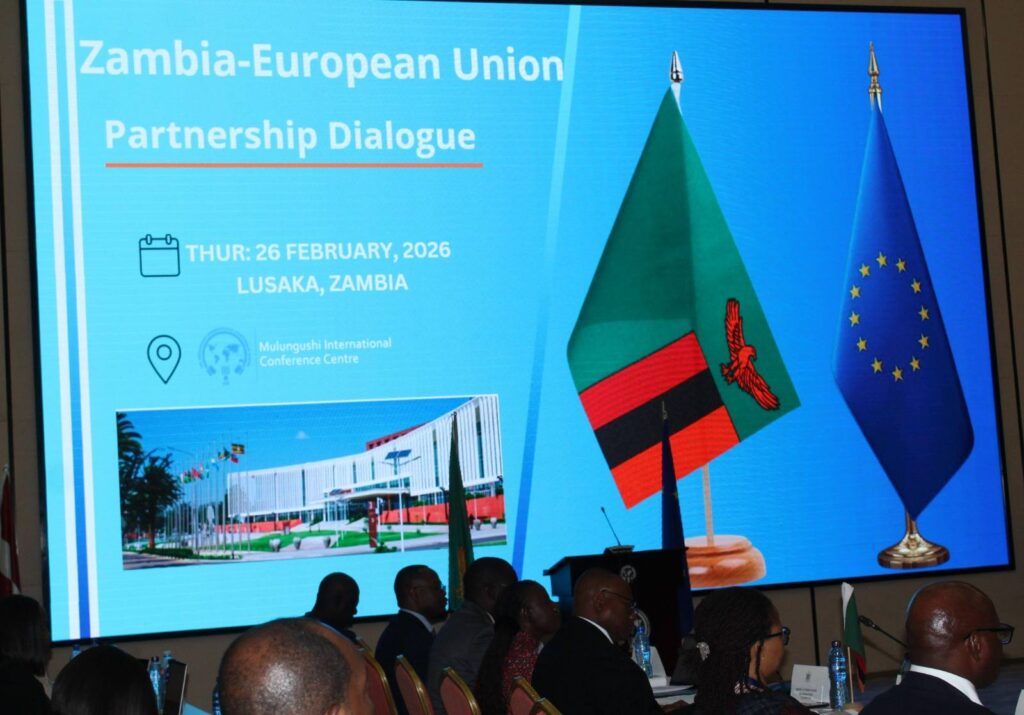
The Government of the Republic of Zambia and the European Union on 26 February convened the 2026 Zambia–EU Partnership Dialogue in Lusaka, reaffirming their long-standing friendship and shared commitment to deepening political and economic cooperation.
Held at the Mulungushi International Conference Centre, the annual high-level engagement highlighted mutual respect, common values, and a collective focus on inclusive and sustainable development.
The Zambian delegation was led by Mulambo Haimbe, SC, MP, Minister of Foreign Affairs and International Cooperation and Acting Minister of Finance and National Planning.
He was accompanied by several Cabinet Ministers, reflecting the breadth of the bilateral partnership across governance, security, infrastructure, mining, technology, trade, water, and environmental sustainability.
The EU delegation was headed by Karolina Stasiak, Ambassador of the European Union to Zambia, alongside Ambassadors and Heads of Mission from EU Member States including Germany, France, Italy, Finland, Sweden, Belgium, Ireland, the Netherlands, Denmark and the Czech Republic.
In his remarks, Minister Haimbe expressed Zambia’s appreciation for the EU’s continued support, particularly during periods of economic difficulty and global uncertainty. He described the Dialogue as a reflection of shared values, notably democracy, human rights, good governance and inclusive development.
He emphasised that Zambia views its engagement with the EU not merely as financial assistance, but as a long-term development partnership anchored in shared responsibility, macroeconomic stability, debt sustainability and sustainable economic recovery.
Minister Haimbe also reaffirmed Zambia’s commitment to democratic governance as the country prepares for the 2026 General Elections. He welcomed the EU’s intention to deploy an Election Observation Mission, noting that such cooperation strengthens transparency, accountability and public confidence in democratic processes.
Permanent Secretary for International Relations and Cooperation at the Ministry of Foreign Affairs and International Cooperation, Etambuyu Anamela Gundersen, said the Dialogue provided an important platform to align Zambia–EU cooperation with national development priorities and to engage on a wide range of critical and emerging issues.
Ambassador Stasiak highlighted that through the Global Gateway 360 approach, the EU and its Member States are mobilising investment to support sustainable and inclusive growth in Zambia.
She also reiterated the EU’s commitment to the development of the Lobito Corridor, describing it as a transformative regional initiative with significant economic potential.
She affirmed that the European Union remains a trusted, reliable and long-term partner for Zambia, despite evolving geopolitical dynamics, pressures on multilateralism, and shared challenges such as climate change and economic volatility.
The 2026 Zambia–EU Partnership Dialogue concluded with both sides reaffirming their commitment to strengthening cooperation in support of Zambia’s development agenda and regional stability.