Ethiopia Takes Steps to Build Stronger Health Workforce
Ethiopia has launched a series of High-Level Multisectoral Dialogues aimed at building a competent, responsive, and equitably distributed health workforce to achieve Universal Health Coverage (UHC).
The initiative, led by the Federal Ministry of Health in collaboration with the Ministry of Education and supported by the World Health Organization (WHO), is funded by the United Kingdom Department for Health and Social Care (DHSC).
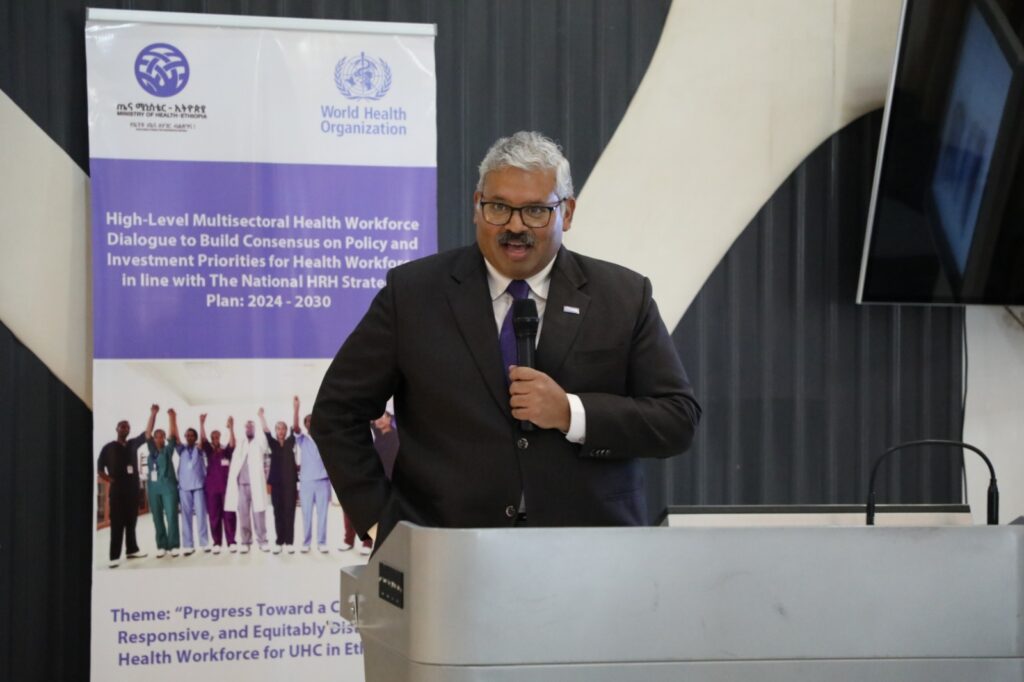
The first dialogue, held on 18 February, brought together senior policymakers, accreditation bodies, global health partners, and leaders from the health, education, and finance sectors.
Discussions focused on Ethiopia’s progress under its Human Resources for Health (HRH) Strategic Plan 2024–2030 and the country’s commitment to strengthening health workforce capacity nationwide.
Over the past decade, Ethiopia has expanded training institutions, improved licensure systems, and formalised community health workers through the Health Extension Programme and health workforce investment compacts. Despite these gains, challenges persist, including workforce quality gaps, inequitable distribution, fiscal constraints, and shifting service delivery needs.
H.E. Mrs Seharela Abdulahi, State Minister of Health, emphasised the need for evidence-based, coordinated action: “Significant gaps remain in the number, distribution, and performance of our health workforce. To address these challenges, we need stronger health financing, multisectoral engagement, coordinated leadership, and harmonised policies. Strong health systems require a strong health workforce.”
The dialogue aimed to review the current workforce landscape, identify priority reforms, strengthen multisectoral coordination, and mobilise political and financial commitments.
Participants highlighted the importance of collaboration between the Ministries of Health, Education, and Finance, alongside professional bodies and development partners, to operationalise the Health Workforce Investment Compact effectively.
Dr Bejoy Nambiar, WHO Health Systems and Policy Advisor in Ethiopia, noted: “These dialogues build a shared understanding of the current health workforce context and the strategic actions needed to strengthen development, retention, and investment for the future.”
The series will continue with dialogues focusing on financing strategies and the co-creation of Ethiopia’s Health Workforce Investment Compact III, translating policy priorities into actionable commitments to sustain a resilient, high-performing health system.