African regional blocs back New African Financial Architecture to close continent’s financing gap
African regional economic blocs have thrown their weight behind the New African Financial Architecture (NAFA), a continent-led framework aimed at mobilising domestic capital, strengthening financial sovereignty and closing Africa’s long-standing development financing gap.
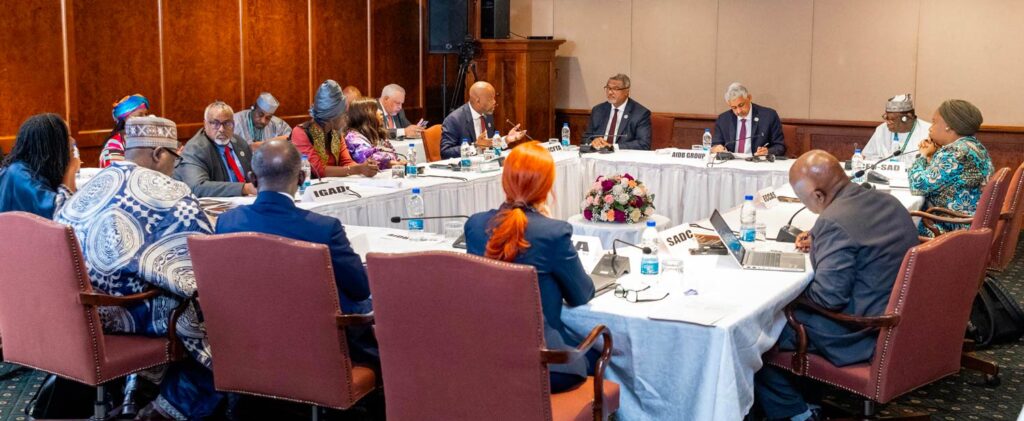
The commitment was made during a high-level working session convened on 15 February by African Development Bank Group President Dr Sidi Ould Tah, held on the margins of the African Union Summit in Addis Ababa.
The meeting brought together chief executives of African Union–recognised Regional Economic Communities (RECs), including Common Market for Eastern and Southern Africa, Economic Community of West African States, Southern African Development Community, the Arab Maghreb Union, the Community of Sahel-Saharan States, the Economic Community of Central African States and the Intergovernmental Authority on Development, alongside the Secretary-General of the African Continental Free Trade Area Secretariat.
In his opening remarks, Dr Ould Tah urged African institutions to move beyond fragmented financial systems towards a coordinated continental architecture capable of unlocking Africa’s capital power. He said NAFA would help rebuild financial sovereignty, support youth employment and scale transformative infrastructure while accelerating industrialisation.
“NAFA is not just a financial plan. It is a blueprint for Africa’s economic transformation,” he said. “It points to a future where Africa finances its development on its own terms, through collaboration, coherence and leadership.”
NAFA is a core pillar of Dr Ould Tah’s “Four Cardinal Points” strategic vision and is intended to reform Africa’s financial systems while amplifying the continent’s collective voice globally. The session marked a key step in aligning regional priorities with a locally anchored financing model to drive sustainable growth and resilience.
Regional leaders welcomed the initiative, outlining practical steps to scale investment in cross-border infrastructure, industrial development and private sector growth. They highlighted the importance of co-financing platforms, regional delivery capacity and risk-mitigation instruments, including guarantees, to de-risk investment pipelines.
Participants also underscored the need to curb illicit financial flows, noting their damaging impact on fiscal sustainability, governance and Africa’s ability to mobilise domestic resources for development.
Francisca Belobe, African Union Commissioner for Economic Development, Trade, Tourism, Industry and Minerals, called for deeper structural reforms and stronger coordination among African institutions. “There is too much fragmentation in our financial and economic efforts,” she said, warning that this weakens scale, visibility and collective impact.
She urged RECs to identify and support African corporate champions to anchor industrialisation and strengthen regional value chains.
AfCFTA Secretary-General Wamkele Mene described NAFA as a timely accelerator for industrialisation and AfCFTA implementation, stressing the need to address Africa’s infrastructure deficit and leverage critical minerals to support regional value chains.
Meanwhile, COMESA Secretary-General Chileshe Kapwepwe said RECs must provide “the wheels of integration” required to originate and package cross-border projects into bankable pipelines. She emphasised market research, policy harmonisation and skills audits, including training in emerging technologies such as artificial intelligence.
The session concluded with a shared commitment built around three pillars: deepening coordination between the African Development Bank Group, RECs and African financial institutions; aligning flagship regional projects with NAFA investment priorities; and promoting accountable, measurable and inclusive impact.
The African Development Bank Group said it would consolidate the outcomes into an implementation roadmap and maintain high-level engagement with partners to translate Africa’s Agenda 2063 into tangible, large-scale development results.