
Zambia Confirms 861 Cholera Cases and 16 Deaths Nationwide
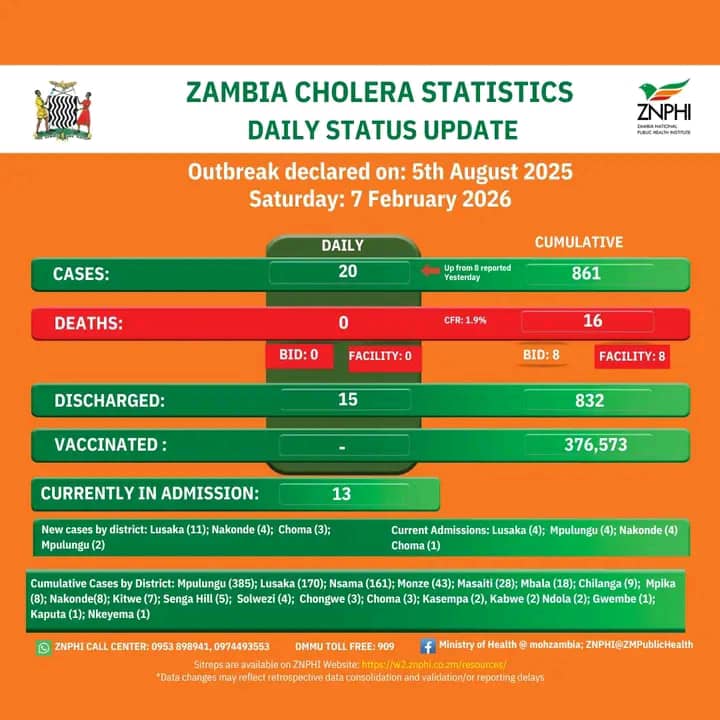
The Government has confirmed that Zambia has recorded a cumulative total of 861 cholera cases and 16 deaths since the outbreak was first detected in Mpulungu District in August 2025, with Lusaka Province now the main driver of transmission, Minister of Health Hon. Dr Elijah Muchima, MP, has announced.
Speaking at a press briefing held at Ndeke House in Lusaka, Dr Muchima said the outbreak, first detected on 5 August 2025, has affected 20 districts across eight provinces, while Luapula and Eastern Provinces have remained free of confirmed cases.
Of the 16 recorded deaths, seven occurred in health facilities and nine in community settings, highlighting the continued need for early symptom recognition and prompt health-seeking behaviour.
Dr Muchima noted that Northern Province, particularly Mpulungu District, remains the epicentre of the outbreak, accounting for about 70 percent of all cases, with 570 infections recorded across five districts. He explained that the prolonged transmission in the area has been driven by environmental contamination, cross-border movement, fishing activities, and persistent gaps in water, sanitation and hygiene.
From November 2025, cholera transmission shifted southwards, with outbreaks reported in Monze District and later Lusaka Province, reflecting urban and peri-urban spread linked to population mobility, informal settlements and sanitation challenges.
Although several districts have achieved the 28-day zero-reporting threshold, Lusaka Province has emerged as the current hotspot, reporting 170 cases and two deaths, with a case fatality rate of 1.2 percent.
The Minister confirmed that seven districts currently have active cholera transmission: Mpulungu (second wave), Lusaka, Chilanga, Nakonde, Solwezi (second wave), Nkeyema and Choma.
In the last 24 hours, 20 new cases were reported from Lusaka (11), Nakonde (4), Choma (3) and Mpulungu (2), with no deaths recorded. The three cases in Choma confirm a new outbreak, making it the third affected district in Southern Province, nearly 70 days after the last reported case in Monze.
Nakonde District, despite reporting fewer cases, has recorded a high case fatality rate, attributed to late detection and community-level vulnerabilities.
As part of the response, the Ministry of Health, working with partners, has administered two doses of oral cholera vaccine (OCV) to at-risk populations in Chainda. Of the 35,700 eligible people, 99.1 percent received the first dose, while 93.2 percent of those reached have received the second dose.
A third dose is scheduled to be administered from 17 to 22 February 2026, and the Minister urged residents to complete the full vaccination course.
The public was also urged to observe hygiene practices, handle food safely, maintain clean surroundings, avoid unsafe food sources, and seek immediate medical care if symptoms such as diarrhoea or vomiting occur.
Dr Muchima said Zambia is also experiencing above-normal rainfall and localised flooding during the 2025–2026 rainy season, partly due to La Niña weather patterns. He noted that the country is part of a wider southern African flooding emergency, affecting an estimated 1.3 million people.
Provinces most affected include Eastern, Southern, Western, Lusaka and Central. In Eastern Province, more than 40,000 people temporarily lost access to safe drinking water after a treatment facility was flooded, while 340 households were impacted and 98 people displaced, mainly in Chama South District.
In Southern Province, flash floods damaged about 846 hectares of farmland, threatening livelihoods and food security. Five flood-related deaths have been reported in Lumezi, Kabwe and Lusaka’s Kanyama and Misisi areas.
Despite these challenges, the Minister assured the nation that disease surveillance systems remain fully functional, health facilities are operational, and no surge in flood-related communicable diseases has been recorded.
On measles, Zambia has recorded 2,549 suspected cases since January 2025, with 243 laboratory-confirmed cases. While numbers remain low in 2026, sporadic cases have been reported in Lusaka, Chitambo and Mushindamo.
Regarding Mpox, the country has recorded 2,261 suspected cases and 399 confirmed cases since 2024, with three deaths, representing a case fatality rate of 0.8 percent. Transmission persists in several provinces, particularly Eastern Province.
Dr Muchima also informed the nation of a World Health Organization alert issued on 30 January 2026 following two confirmed Nipah virus cases among healthcare workers in India. He said Zambia has adequate laboratory capacity to detect the virus and is strengthening preparedness under the International Health Regulations.
In closing, the Minister urged citizens to remain alert, follow public health guidance, and seek medical care early, assuring the nation that government remains committed to protecting lives through coordinated national and community-level action.