
AI Technology Helps Bridge Gaps in Tuberculosis Care for Underserved Communities
Artificial intelligence (AI) is increasingly being used to expand access to essential health services for underserved populations, challenging the perception that advanced technology only benefits wealthy societies. Across the Global South, AI-driven innovations are helping overcome long-standing barriers in public health, particularly in the fight against tuberculosis (TB), the world’s deadliest infectious disease.
As the Asia Pacific Regional Conference of the International Union Against Tuberculosis and Lung Disease (APRC 2026) approaches, attention is turning to how AI is transforming TB detection and care. Early and accurate diagnosis remains critical to ending TB, yet millions of cases continue to go undetected each year, allowing transmission to persist and preventable deaths to occur.
One of the major challenges has been identifying TB in people without symptoms. Studies show that nearly half of TB cases are asymptomatic and can only be detected through chest X-rays. However, access to radiology services and trained specialists remains limited in many low- and middle-income countries. AI-powered computer-aided detection software has emerged as a solution, enabling rapid interpretation of digital chest X-rays where human expertise is scarce.
In July 2021, the World Health Organization (WHO) formally recommended the use of AI-based software for TB screening and diagnosis, marking a historic shift in global health guidance. Research has since shown that these AI tools can achieve accuracy comparable to that of trained radiologists, making them especially valuable in remote and resource-constrained settings.
Several countries in Asia and the Pacific are now using AI-enabled, portable X-ray machines to screen high-risk groups such as migrant workers, people experiencing homelessness, and prison populations. These battery-operated devices can be deployed in hard-to-reach areas, bringing diagnostic services directly to communities that are least likely to access formal healthcare facilities.
India, which carries the world’s highest TB burden, made a major policy shift in December 2024 by introducing AI-enabled handheld X-rays for mass screening in high-risk settings nationwide. Within the first 100 days of implementation, more than 120 million people were screened, leading to the identification of over 285,000 TB cases among individuals without symptoms. Health authorities credit AI technology as the key factor in uncovering these previously missed cases.
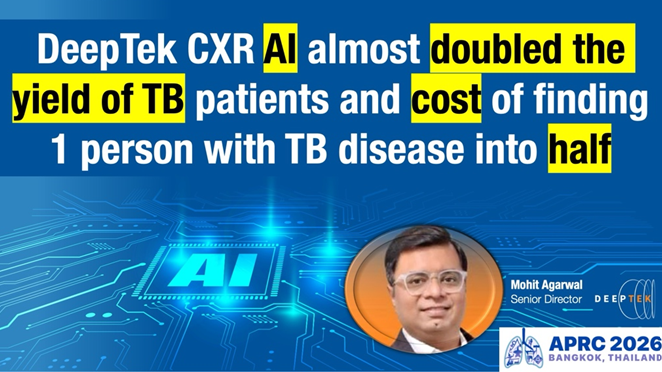
AI has also proved to be cost-effective. Government-led health technology assessments in India have shown that AI-supported interpretation of chest X-rays meets WHO performance standards and reduces the cost of detecting each TB case by nearly half. By triaging patients for confirmatory molecular testing, AI helps health systems use limited resources more efficiently while improving outcomes.
Among the technologies gaining global attention is DeepTek’s CXR AI, known as Genki, which is capable of detecting TB and more than 20 other chest conditions within seconds. The platform has been recommended by the WHO and is currently deployed in over 1,000 hospitals and imaging centres, as well as hundreds of public health screening sites worldwide. Regulatory approvals have been granted across multiple regions, including parts of Africa, Asia, Europe and North America.
According to DeepTek, the use of Genki in parts of southern India nearly doubled the rate of TB detection compared to traditional symptom-based screening alone. The company also emphasises its focus on “responsible AI”, continuously validating AI outputs against laboratory results and clinical reviews to ensure accuracy across different populations and settings.
Public health experts say the expanding use of AI, combined with portable diagnostic tools, is placing low- and middle-income countries in a stronger position than ever before to deliver multi-disease screening at the point of care. As governments strive to meet global commitments to end TB by 2030, advocates argue that embracing evidence-based AI solutions will be essential to ensuring equitable access to healthcare and leaving no one behind.