
Single-Digit Inflation Brings Cost-of-Living Relief to Zambians
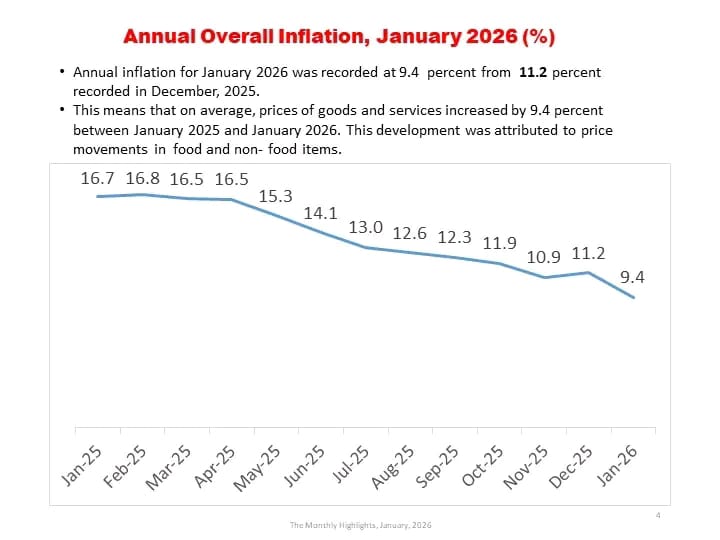
Zambia’s annual inflation rate fell to single digits in January 2026, easing to 9.4 per cent from 11.2 per cent recorded in December 2025, the Zambia Statistics Agency (ZamStats) has announced.
The figures were released on Tuesday during the monthly media briefing for January. Acting Statistician General, Mrs Sheila Mudenda, said the slowdown in inflation was mainly driven by easing price movements in both food and non-food items, indicating a slower rate of increase in consumer prices.
Mrs Mudenda said annual food inflation declined to 10.9 per cent in January 2026 from 12.9 per cent in December 2025. This means that, on average, food prices rose by 10.9 per cent between January 2025 and January 2026.
She attributed the deceleration in food inflation to price movements in key food categories, including cereals such as breakfast mealie meal, roller mealie meal, maize grain, imported rice and household wheat flour; fruits including oranges, lemons, apples and pineapples; vegetables such as pumpkin leaves, sweet potato leaves, okra, tomatoes, cucumber, impwa, green pepper and maize cobs; as well as cooking oil.
Provincial annual inflation rates declined across all ten provinces. Lusaka and Western provinces recorded the highest annual inflation rates at 12.2 per cent each, while Luapula Province registered the lowest at 4.4 per cent.
Meanwhile, Zambia recorded a trade surplus of K1.0 billion in December 2025, an improvement from the K0.6 billion surplus recorded in November 2025.
Exports, mainly comprising domestically produced goods, increased by 3.9 per cent from K28.1 billion in November 2025 to K29.2 billion in December 2025. This growth was largely driven by higher export earnings from intermediate goods, which rose by 3.4 per cent, raw materials by 15.8 per cent, and capital goods by 0.7 per cent.
Imports also increased, rising by 7.3 per cent from K25.6 billion in November 2025 to K27.5 billion in December 2025. The increase was mainly due to higher import bills for capital goods, which grew by 20.1 per cent, intermediate goods by 8.5 per cent, and raw materials by 14.9 per cent.