“Aviation Safety Is Non-Negotiable,” Says CAA as NASC Convenes
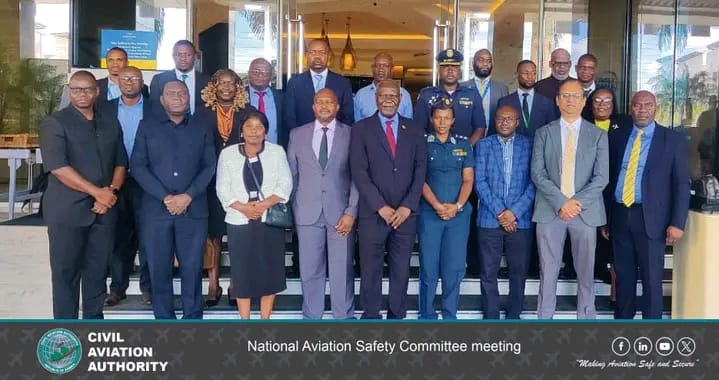
The Civil Aviation Authority (CAA) on Tuesday, 27 January 2026, hosted a meeting of the National Aviation Safety Committee (NASC), a high-level multi-stakeholder body responsible for coordinating and strengthening aviation safety in Zambia in line with International Civil Aviation Organisation (ICAO) Standards and Recommended Practices.
Speaking during the meeting, CAA Director General, Captain Derrick Luembe, said the engagement came at a critical time as the aviation sector renews efforts to strengthen the implementation of Zambia’s State Safety Programme (SSP).
Captain Luembe noted that, as the principal national coordination platform for aviation safety, the NASC plays a vital role in reviewing safety performance, setting strategic priorities and ensuring that safety initiatives are implemented in a coordinated, effective and sustainable manner across all relevant institutions.
He said discussions at the meeting focused on key issues, including the status of SSP implementation, the national aviation safety risk overview for the 2024–2025 period, and the review of core safety governance documents. These included the updated State Safety Programme Policy, the enhanced draft National Aviation Safety Plan and the draft State Safety Programme document.
Captain Luembe explained that the reviews are essential to ensuring Zambia’s aviation safety framework remains aligned with ICAO requirements, global and regional safety plans, and the realities of the national operational environment.
Under ICAO Annex 19 on Safety Management, States are encouraged to establish SSP coordinating groups to support the implementation of the National Aviation Safety Plan and the State Safety Programme.
The National Aviation Safety Committee is mandated to coordinate aviation safety activities at national level, oversee the implementation of the State Safety Programme, identify and mitigate safety risks, promote a positive safety culture across the sector, and improve safety performance through data-driven and risk-based approaches.
Institutions represented at the meeting included the Ministry of Transport and Logistics, the Aircraft Accident Investigation Board, Zambia Air Services Training Institute, Zambia Meteorological Department, Department of National Parks and Wildlife, Zambia Information and Communication Technology Authority, the Zambia Air Force, Zambia Airports Corporation Limited, and Search and Rescue, with the CAA hosting.
Captain Luembe thanked all participating stakeholders for their continued commitment to strengthening aviation safety, noting that their collaboration reflects effective collaborative decision-making within the national aviation system.