
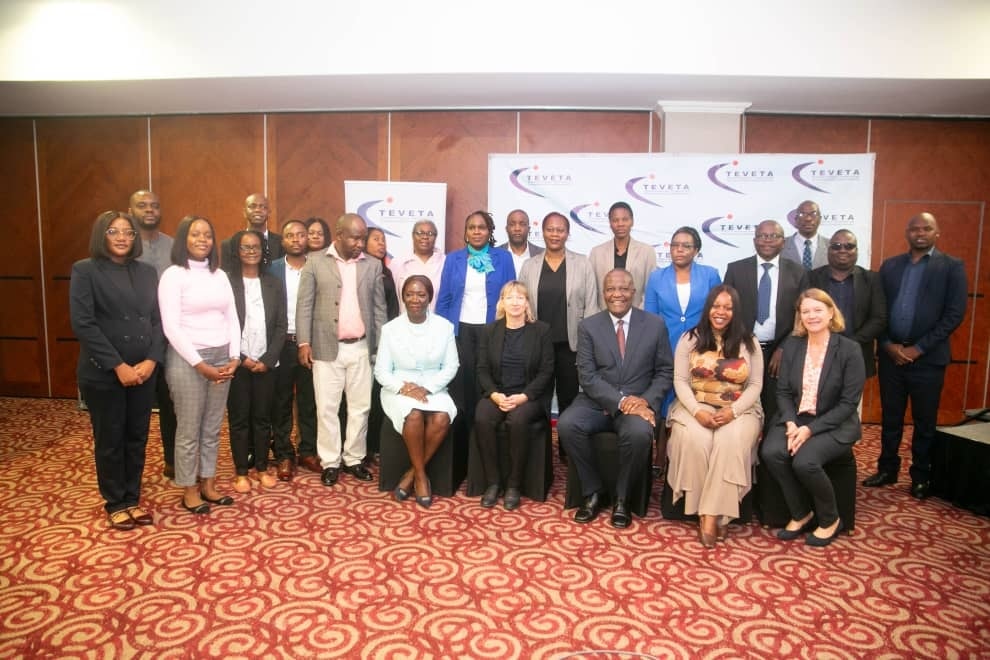
TEVETA Brings Partners Together to Drive Skills Transformation in Zambia
The Technical Education, Vocational and Entrepreneurship Training Authority (TEVETA) has convened its first-ever Cooperating and Implementing Partners’ Meeting, marking a significant step in strengthening collaboration to accelerate skills development for economic transformation, job creation and wealth generation in Zambia.
Held on 17 December 2025, the meeting brought together Government officials and development partners to reflect on shared achievements, improve coordination and align partner-supported interventions with national priorities in the Technical Education, Vocational and Entrepreneurship Training (TEVET) sector.
Speaking at the meeting, Minister of Technology and Science, Mr Felix Chipota Mutati, said 2025 represents a year of harvesting the dividends of partnership and collaboration in the TEVET sector. He noted that progress achieved in recent years demonstrates that effective coordination, rather than the availability of resources alone, is key to maximising impact.
“The challenge before us is not the lack of resources, but how we optimise and coordinate what is already available to eliminate duplication, close gaps and ensure value for money,” the Minister said.
Mr Mutati outlined five key pillars guiding Government’s approach to transforming the TEVET sector in 2025 and beyond. These include expanding access and ensuring financial sustainability through the integration of the Skills Development Fund and the Constituency Development Fund, which has seen enrolment grow from about 38,000 learners in 2021 to nearly 100,000 in 2025.
He said Government is also prioritising demand-driven skills development, with curricula increasingly aligned to industry needs in key sectors such as mining, agriculture, tourism and manufacturing, to improve graduate employability and productivity.
The Minister commended Cooperating Partners, including GIZ, UNIDO, JICA and the World Bank, for strategic investments in infrastructure, equipment, renewable energy and specialised training that are helping to produce globally competitive graduates.
He further highlighted ongoing efforts to strengthen lecturer and trainer capacity through attachments and training programmes in countries such as Zimbabwe and South Africa, as well as planned legal reforms. The proposed TEVET Bill is expected to create clear career progression pathways up to postgraduate level, repositioning vocational education as a first-choice option.
Mr Mutati emphasised that Zambia’s national development goals, including increased copper production, agricultural output and energy resilience, depend on a strong, responsive and well-coordinated TEVET system, supported by robust partnerships.
The Government reaffirmed its commitment to working closely with Cooperating and Implementing Partners to deliver practical skills, sustainable livelihoods and inclusive national development as the country looks beyond 2025.