Zambia Signs Historic Carbon Agreement to Boost Climate Action
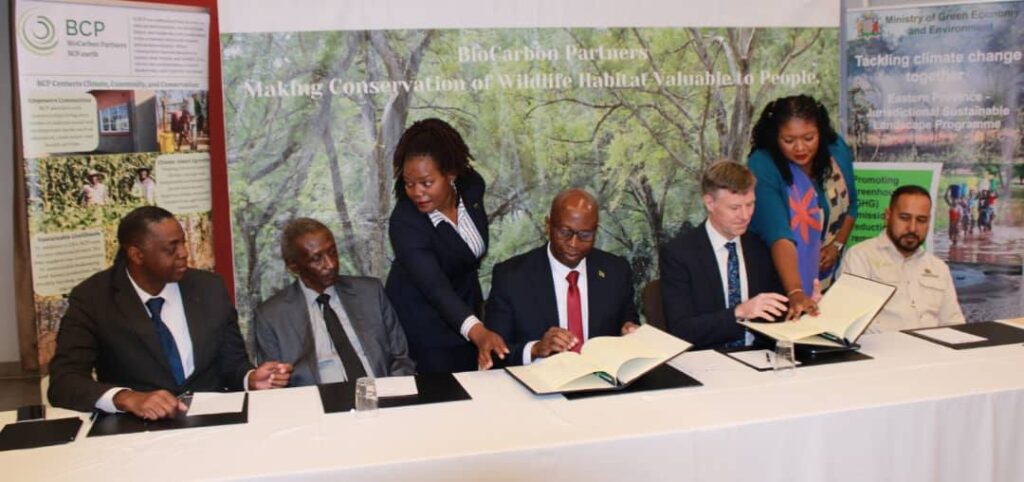
The Government of Zambia has taken a significant step forward in climate action, sustainable land management and community development following the signing of the Nested Emission Reduction Performance Agreement (NERPA) between BioCarbon Partners (BCP) and the Eastern Province Jurisdictional Sustainable Landscape Programme (EP-JSLP).
The agreement was formalised at a high-level ceremony officiated by the Permanent Secretary in the Ministry of Green Economy and Environment, Dr Douty Chibamba, who delivered remarks on behalf of the Minister of Green Economy and Environment, Mike Elton Mposha, MP.
Speaking at the event, Dr Chibamba described the signing as a milestone of national importance, highlighting the Government’s commitment to climate mitigation, community resilience and responsible stewardship of natural resources.
“This ceremony represents far more than the signing of an agreement. It symbolises a strengthened partnership between government, the private sector and communities in delivering credible, transparent and inclusive carbon market outcomes,” he said.
The NERPA formalises the integration of BioCarbon Partners, a private REDD+ developer, under the Eastern Province Jurisdictional Sustainable Landscape Programme. This approach aligns private carbon projects with government-led jurisdictional frameworks, improving transparency, accountability and integrity in the generation and distribution of carbon credits.
Dr Chibamba noted that the agreement builds on the successful conclusion of 56 Chiefdom Emission Reduction Performance Agreements across Eastern Province, reflecting the strong commitment of traditional leaders and rural communities to forest conservation and sustainable land-use practices.
Under the EP-JSLP, Eastern Province is projected to generate approximately 28.9 million tonnes of carbon credits, to be sold to the World Bank and other international buyers. Revenue from these credits will be shared according to an agreed benefit-sharing plan, with 55 per cent allocated to communities, 30 per cent to private project developers, and 15 per cent to government and programme operations.
The Government has already secured USD 30 million from the World Bank for the purchase of 3 million tonnes of verified emission reductions. The NERPA will enable the transparent allocation of these funds to BioCarbon Partners based on performance in implementing mitigation initiatives such as sustainable forest management, climate-smart agriculture and the distribution of energy-efficient cookstoves.
World Bank Country Manager for Zambia, Dr Achim Fock, praised the partnership, describing it as a model for effective public–private collaboration in tackling climate change.
He noted that the Eastern Province Jurisdictional Sustainable Landscape Programme demonstrates how integrated approaches can deliver emission reductions while improving livelihoods, food security and economic growth.
BioCarbon Partners Chief Executive Officer, Mr Nicholas Mudaly, welcomed the agreement as a historic achievement that fully integrates the Luangwa Community Forest Project into Zambia’s national jurisdictional REDD+ system. He emphasised BCP’s long-standing commitment to high-integrity carbon standards, strong safeguards and community-centred benefit sharing.
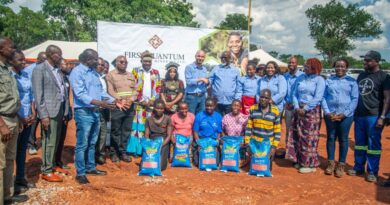
During the ceremony, dummy cheques and ATM cards were presented to symbolise USD 3 million in community carbon payments to chiefdoms under the Luangwa Community Forest Project, marking the final payments under the previous project structure and the transition into the jurisdictional programme.
In a vote of thanks on behalf of the chiefs, Chieftainess Msoro of Mambwe District applauded the Government, the World Bank and BioCarbon Partners for ensuring that forest protection translates into tangible benefits for communities. She highlighted the crucial role of community scouts and local custodians whose efforts make forest conservation possible.
As the ceremony concluded, the Government reaffirmed its unwavering commitment, under the leadership of President Hakainde Hichilema, to building a green economy that delivers real benefits to rural households while strengthening Zambia’s contribution to global climate solutions.