Bank Programme Turns Former Child Miners into Skilled Youth
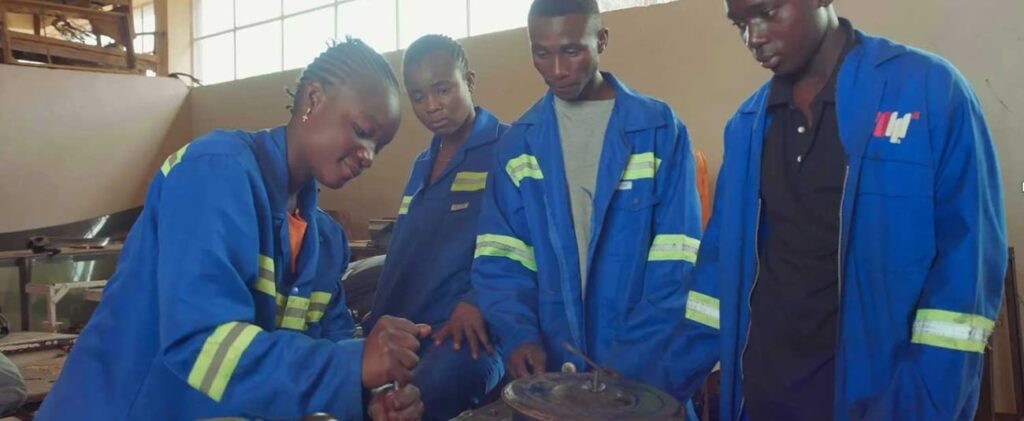
Former child mine worker Divine Komba is now a teenager learning to become a mechanic through a school and vocational skills programme funded by the African Development Bank (AfDB).
During the festive season, many popular gifts – including mobile phones, laptops, tablets, portable power tools, and wearable technology – rely on rechargeable lithium-ion batteries powered by cobalt. Yet behind these high-tech products lies a hidden human cost.
Cobalt, a critical mineral abundantly mined in Africa, often robs young people of their childhoods. Divine Komba spent years working in hazardous artisanal cobalt mines in the Democratic Republic of Congo (DRC). She endured long hours, skin rashes, illnesses, and earned barely two dollars a day.
“We didn’t like this work, but we had no choice – to eat, we had to work in the mine,” Komba said.
Rising food prices, rural poverty, and limited opportunities have forced orphans, young parents, and families to bring children into cobalt mines to survive.
The African Development Bank’s Alternative Well-Being Support Project for Children and Youth Involved in the Cobalt Supply Chain is now helping thousands of children like Komba return to school or access vocational training, building resilient and prosperous futures. The initiative forms part of the Bank’s continent-wide skills revolution, which recognises women and youth as engines of Africa’s economic growth.
The programme operates in the DRC’s Lualaba and Haut-Katanga Provinces, home to more than 65 per cent of global cobalt reserves. Cobalt remains essential for products ranging from rechargeable batteries in electric cars and mobile phones, to medical equipment and renewable energy technologies like wind turbines.
Through the programme, Komba is enrolled in automotive mechanics training at the Bank-supported Ruashi Social Promotion Centre in Haut-Katanga. “We had to work to survive. Mining made us sick. Today I earn a living fixing cars. I encourage other girls to join the programme and study,” she said.
The project has identified more than 16,800 children at risk of working in cobalt mines and integrated 13,587 into school systems. It aligns with the DRC Government’s national strategy to eliminate child labour in copper and cobalt production, and is supported by Germany’s development agency, GIZ.
Thirteen-year-old Beni Ciel Yumba Musoya is one of the children now back in school. She used to collect minerals at Kasulo mine in Lualaba Province and now dreams of becoming a doctor. Her relative, Jocelyne Kazadi, explained, “[The programme] has improved life for my whole family. Thanks to the Government, the African Development Bank and local partners, the children are back in school and dreaming again.”
To address the financial pressures that drive child labour, the programme also supports parents and adults with sustainable income-generating opportunities in agriculture. For instance, Komba’s mother received support to raise chickens and joined a poultry cooperative.
The programme has helped approximately 10,500 young parents, more than half of them women, transition into agribusiness activities such as livestock farming. Project partners have established 77 per cent of a target 1,250 agricultural cooperatives, opened two youth agribusiness centres providing training in small-scale agriculture and mining trades, and installed agricultural machinery, livestock facilities, and fish farms.
“The project shows that tackling child labour also means investing in the economic transformation of communities, with a focus on empowering girls and women. Gender equality is a catalyst for lasting change,” said Juliette Ayuknow Egbe, Gender Officer at the African Development Bank.
Children working in mines are often in remote areas. The project supports the rehabilitation, construction, and equipping of 40 education, health, water, and sanitation facilities in the targeted provinces.
Once fully implemented, the programme is expected to create 11,250 direct jobs and thousands more indirectly, increase locally produced staple foods from 10 per cent to 50 per cent, and benefit 1.4 million people in Lualaba and Haut-Katanga. Overall, the project has the potential to impact over 5.6 million people.
“Supporting women, especially young women, through agricultural cooperatives and income-generating activities helps reduce rural poverty and keeps children out of mines,” said Project Coordinator Alice Mirimo Kabetsi. “Agriculture, particularly quick-return activities like poultry farming, provides a practical, sustainable alternative. Providing economic options to parents is providing a future for their children.”